
 Dr. Shikaha Mishra
When Outrage Loses the Plot
India’s response to violence against women and other issues has become a familiar cycle of collective outrage, emotional media coverage, political statements and symbolic gestures, followed by silence and systemic inertia. Why do even the most shocking crimes and failures rarely translate into meaningful institutional reform in India?

Sharda AL
Guest Editor
- Founder Director of Population First and currently a Trustee on its Board.SharSh
- Associated with the organisation since its inception, contributing significantly to its growth and development.
- Played a key role in shaping the vision, direction and major initiatives of the organisation.
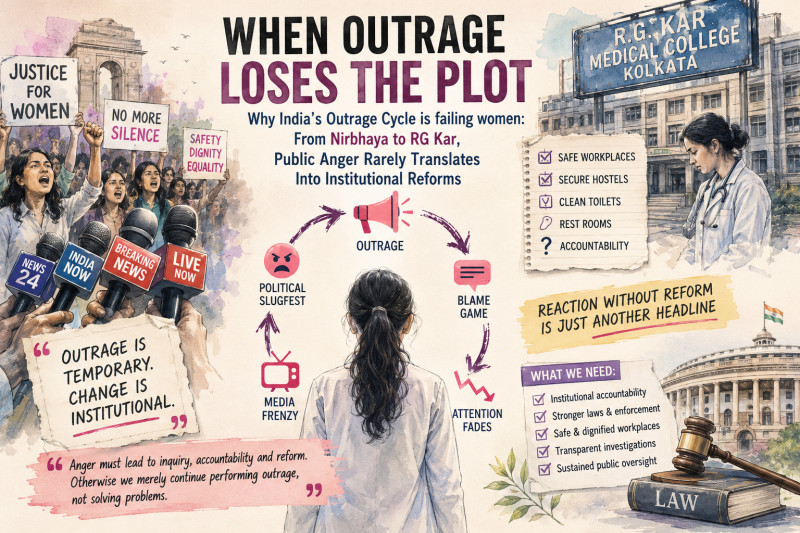
Every time a shocking crime against a woman takes place in India, the reaction follows a familiar pattern. Television studios erupt, hashtags trend, political parties begin attacking each other and social media fills with outrage. For a few days, the issue dominates public attention. Then slowly, somewhere in all the shouting, the real issue begins to disappear.
I often feel that in India we lose some of our biggest opportunities for systemic reform because every tragedy quickly turns into a political slugfest. Instead of examining institutional failures and demanding concrete changes, we get trapped in ideological battles, moral posturing and endless blame games.
If we look back, there have only been a few moments when public outrage after gender-based violence actually led to meaningful reform. The Mathura rape case forced the country to revisit laws around custodial rape and consent. The Bhanwari Devi case eventually led to the Vishaka Guidelines on workplace sexual harassment. The Nirbhaya case resulted in major legal reforms and serious discussions on women’s safety.
These moments mattered because the focus remained substantially on changing systems and institutions.
But many other incidents do not travel that path.
Take the horrific rape and murder case at RG Kar Medical College in Kolkata. Public anger was entirely justified. Yet very soon the conversation shifted almost completely towards political affiliations, patronage networks and party rivalries. Corruption within institutions and political protection certainly deserve scrutiny. But another equally important discussion vanished almost immediately.
Why are hospitals across the country still unsafe and undignified spaces for women professionals? Why do resident doctors and nurses working night shifts often not have proper resting rooms, secure dormitories, clean toilets or even decent cafeteria facilities? Why are female attendants and patients expected to manage in such chaotic environments?
The young doctor was not walking alone on a deserted road at midnight. She was inside her workplace, a hospital, an institution that should have been among the safest places for a woman.
After all the outrage, did any nationwide audit of hospital safety facilities take place? Did health departments seriously examine the working conditions of medical professionals? Was there any sustained national conversation on making hospitals safer for women employees?
I did not see much evidence of that. Instead, the debate became increasingly political.
Even after shocking crimes like the RG Kar rape and murder case trigger national protests, the response often remains confined to Supreme Court-appointed committees, guidelines and procedural announcements, with little clarity on implementation, accountability, budgetary commitment or consequences for failure. Why does the country continue to react to each tragedy as an isolated incident instead of confronting the deeper systemic failures that enable such violence?
And this pattern is not limited to crimes against women.
I still remember the case of a child falling into an abandoned borewell. Television channels covered the rescue operation for hours while anchors angrily demanded accountability from ministers and senior officials. But the law in such cases is quite clear. The responsibility for sealing failed borewells lies primarily with the individual who commissioned the work and the company that carried it out.
Authorities can certainly be questioned for weak enforcement or failure to punish violations. But when discussions become reduced to dramatic outrage directed vaguely at “the system”, the actual offenders often disappear from scrutiny.
Unfortunately, the same pattern is now visible even in parliamentary discussions. Debates often begin well. Important issues are identified clearly. Data is presented. Gaps in implementation are pointed out. For a brief moment, one feels hopeful that serious democratic engagement may happen.
And then the discussion collapses into sweeping accusations and moral grandstanding.
Instead of seeking clarifications or demanding specific responses, both sides begin attacking each other’s motives and ideology. The treasury benches and opposition benches settle into a predictable confrontation. Television channels amplify the most dramatic exchanges. Social media circulates clipped videos designed to provoke outrage rather than understanding.
Meanwhile, the core issue remains inadequately discussed.
One rarely hears sustained discussion on practical questions. What exactly will change? Who will implement it? What timelines are being proposed? How will accountability be monitored? What happens if institutions fail again?
Perhaps this happens because outrage is easier to communicate than complexity. Nuanced discussions demand patience and sustained attention. Anger is emotionally satisfying and visually dramatic. As a result, many important advocacy moments get wasted.
This is particularly worrying because every major tragedy briefly opens a window for reform. Citizens are emotionally engaged. Governments are under pressure. Media attention is focused. Experts are willing to contribute. These are the moments when structural changes become politically possible.
Perhaps activists and advocacy groups too need to guard against this drift. Public anger is often necessary to draw attention to injustice. Without emotional mobilisation, many issues would never receive attention at all. But if movements do not remain anchored to specific institutional demands and measurable reforms, outrage can easily get absorbed into the endless cycle of political spectacle.
And then the opportunity is lost. A democratic society certainly needs outrage. A society that does not react emotionally to injustice becomes morally numb. But outrage alone is not enough. Anger must eventually lead to inquiry, accountability and reform.
(* The opinion and thoughts expressed in this article are author’s personal views on the issue.)