
 Dr. Shikha Mishra
Dr Shikhha Mishra
Editor, Lead Reporting
Ph.D. & M.Phil. in Journalism and Mass Communication
Editorial experiences with—The Indian Express, The Pioneer, and Hindustan Times
A seasoned journalist, senior media educator and researcher with 19+ years of experience
Author and Patent Holder
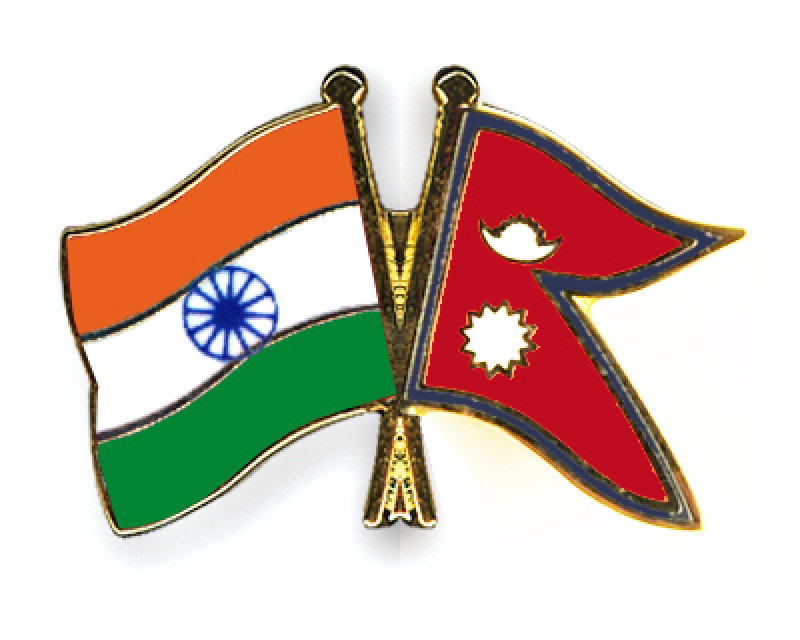
The existing Prime Minister of Nepal and Kathmandu Metropolitan City Mayor Balendra "Balen" Shah has come under sharp public criticism following the introduction of Rs100 levy on goods carried by individuals across the Indo–Nepal border. Though Shah has taken this extreme step to give a push to Nepal economy but it seems to get backfired at him only. The move has triggered widespread resentment among Nepali citizens, particularly small-scale traders and daily cross-border commuters who depend on informal retail trade for their livelihood. Critics argue that the tax, though modest in value, disproportionately impacts low-income groups and disrupts long-standing people-to-people trade practices along the open border. The controversy has quickly escalated into a broader debate over economic strain, policy intent, and its potential implications for grassroots cross-border commerce between India and Nepal.
What the policy is?
On the Nepal side, Prime Minister Balendra Shah’s government has begun strictly enforcing an existing rule that mandates customs duty (“Bhansar”) on any goods purchased in India exceeding NPR 100 (roughly Rs 63 INR) when brought across the open India–Nepal border.
- Previously, small personal purchases below NPR 100 were effectively exempted from formal custom checks, and many cross-border shoppers operated in a grey zone.
- Since mid-April 2026, custom officials at crossings like Birgunj–Raxaul, Banbasa, and other Uttarkhand, Uttarpradesh and Bihar/Nepal border points are conducting thorough bag and vehicle checks and charging taxes that can range from 5% to as high as 80% depending on the item.
This is not a brand-new law; it is a rigorous enforcement of an older regulation that had been issued during the Oli government but was not seriously implemented until now.
Impacts on Uttarakhand
The enforcement of Nepal’s NPR 100 (≈Rs63) customs duty on Indian goods is hitting Uttarakhand’s border economy harder than most other Indian states, because this state shares a 348-km open border with Nepal and has multiple active trade corridors in districts like Champawat, Pithoragarh, Udham Singh Nagar, and parts of Nainital and Bageshwar. These districts have long thrived on daily cross-border retail, agricultural exchange, and informal trade that thrived under the traditionally relaxed enforcement of customs rules.
Historical and structural trade flow: Uttarakhand–Nepal
a) Strategic importance of Uttarakhand’s border
Uttarakhand shares its entire eastern boundary with Nepal, from Pithoragarh in the east to Udham Singh Nagar and Champawat in the south, along rivers like the Kali (Mahakali) and Sharda.
There are five key suspension footbridges in Pithoragarh district alone connecting India and Nepal: Dharchula, Jauljibi, Jhulaghat, Balakot, and Daura, facilitating both formal and informal trade for dozens of villages on both sides.
The open border under the 1950 Indo-Nepal Treaty has historically allowed visa-free movement and low‑barrier retail trade, making Uttarakhand’s border towns natural shopping and logistics hubs for Nepali citizens.
b) Long-standing role of Champawat and Pithoragarh
Champawat district (especially Banbasa) is the main commercial gateway for trade between Kanchanpur district of Nepal and Uttarakhand.
Pithoragarh district, bordering Nepal’s Baitadi and Darchula along the Kali River, has been a historical trade corridor for centuries, linking Kumaon with western Nepal. Academic studies on Pithoragarh–Nepal trade describe it as a crucial conduit for cross-border commerce where no visa or passport is required, supporting both formal and informal trade for small farmers, traders, and daily wage earners.
Formal infrastructure and trade ambitions of Uttarakhand
Uttarakhand has been investing heavily to formalize and expand the trade with Nepal in past. The Rs500-crore Banbasa Land Port in Champawat is one the most prominent step taken by the UK Government and the chief minister Pushkar Singh Dhamihas called it as –“The Formal Gateway” for industrial and Agricultural produce enabling faster movement and transparency by reducing middlemen and high transit costs. It was clear that Uttarakhand was eyeing to transform its’ border villages into active trade hubs and create jobs in logistics, warehousing, customs, and transport.
The aftermaths of enforcement of Nepal Tax
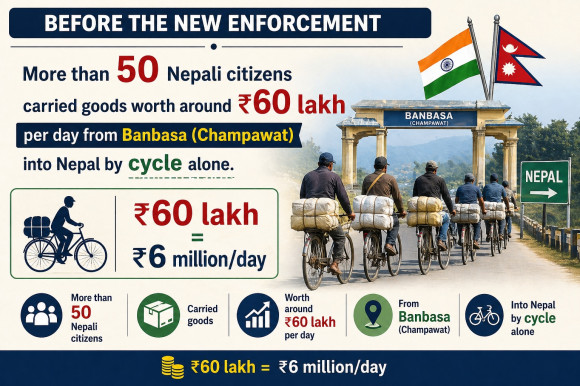
Before the recent enforcement- measures, cross-border retail activity at Banbasa in Champawat witnessed significant daily movement, with more than 50 Nepali citizens transporting goods into Nepal primarily by bicycle. The value of this cycle-based trade alone was estimated at around Rs60 lakh per day—equivalent to approximately Rs 6 million—highlighting the scale and economic importance of this informal but consistent cross-border exchange.
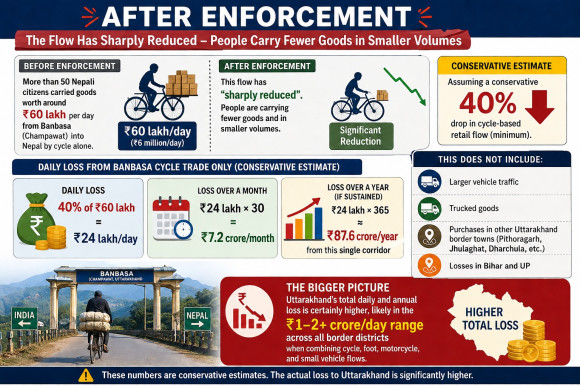
After enforcement- Following the recent enforcement measures, the cross-border cycle-based retail flow from Banbasa has sharply declined, with traders now carrying fewer goods in smaller quantities. Based on a conservative estimate of a 40% reduction in this trade, the daily loss from Banbasa’s cycle corridor alone is pegged at around Rs 24 lakh, down from the earlier Rs60 lakh per day. This translates into an estimated loss of Rs7.2 crore per month and approximately Rs 87.6 crore annually if the trend continues. However, these figures account only for cycle-based movement and exclude larger vehicle traffic, trucked goods, and purchases in other Uttarakhand border towns such as Pithoragarh, Jhulaghat, and Dharchula, as well as parallel impacts in Bihar and Uttar Pradesh. When these additional factors are considered, the overall economic impact is significantly higher, with total losses across border districts likely ranging between Rs1–2 crore or more per day, combining cycle, foot, motorcycle, and small vehicle trade flows.
What Nepal Gains?
Nepal has estimated that it has been losing nearly Rs500 crore annually (approximately NPR 6.5–7 billion) due to informal and untaxed cross-border trade with India, according to reports from April 2026. This figure reflects the revenue gap created by small-scale purchases and semi-formal trade that previously operated under relatively relaxed enforcement. Officials indicate that this is not a post-policy loss but rather the historical revenue leakage the government aims to recover through stricter taxation measures, including levies on goods above NPR 100. If effectively implemented, the policy could enable Nepal to recoup up to Rs500 crore per year in customs revenue, depending on compliance levels and applicable duty rates, marking a significant shift toward formalizing border trade.
The flip side of the story for India
|
State |
Daily Trade Loss |
Monthly Loss |
Annual Loss (12 months) |
|
Bihar |
Rs5–6 crore/day |
Rs150–180 crore |
Rs1,825–2,190 crore |
|
Uttar Pradesh |
Rs2–3 crore/day |
Rs60–90 crore |
Rs730–1,095 crore |
|
Uttarakhand |
Rs1–2 crore/day |
Rs30–60 crore |
Rs365–730 crore |
|
Total (India Border States) |
> Rs10 crore/day |
> Rs300 crore/month |
> Rs3,900 crore/year |
India’s Ministry of External Affairs has acknowledged Nepal’s new border enforcement and is closely monitoring developments. It raised concerns over disruptions to routine cross-border movement but noted the move targets informal trade and smuggling. Kathmandu has clarified that civilians carrying household goods for personal use will not be stopped.
Nepal’s new customs enforcement is triggering significant economic fallout across India’s border states, with trade losses estimated at over Rs10 crore per day across Bihar, Uttar Pradesh, and Uttarakhand according to various financial and media reports. If sustained, annual losses could reach Rs3,900 crore. The policy has disrupted the long-standing low-friction border trade system, tightening movement and increasing costs, with Bihar and Uttar Pradesh facing the heaviest impact on trade, jobs, and local economies.