
 L R Bureau
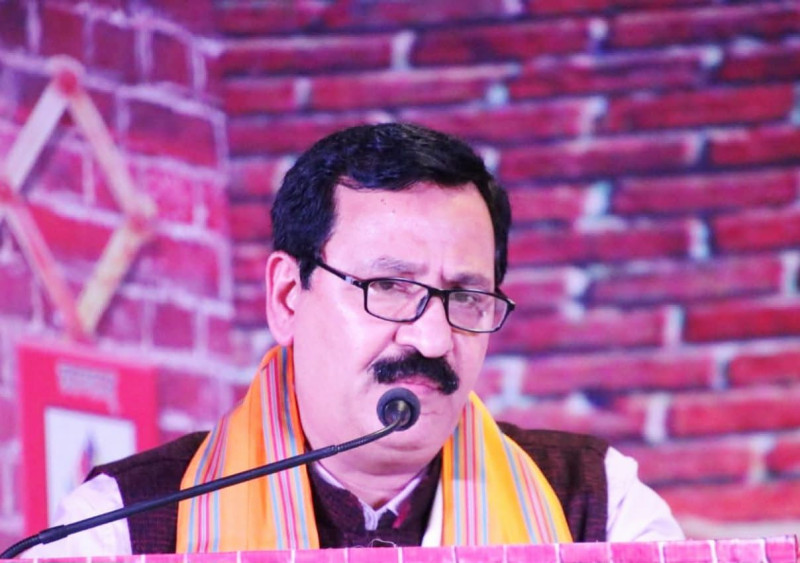
Narad’s Dialogue Was Always Meant for Public Welfare: Prof. Sanjay Dwivedi
“Awareness of the Self is Essential for National Development,” says Vice-Chancellor Prof. Vinay Kumar Pathak
Kanpur: Former Director General of the Indian Institute of Mass Communication, Prof. Sanjay Dwivedi, said that the popular image associated with Devarshi Narad is far removed from his true character and contribution. Contrary to the common perception of Narad as a creator of conflict and discord, every dialogue initiated by him was rooted in the larger objective of public welfare and social harmony.
Prof. Dwivedi was delivering an online special lecture organised by the Department of Journalism and Mass Communication at Chhatrapati Shahu Ji Maharaj University on the occasion of Narad Jayanti. The lecture was themed “Awareness of the Self in Nationalist Journalism” and focused on the values, responsibilities, and nation-building role of journalism and media. The programme was presided over by the university’s Vice-Chancellor, Prof. Vinay Kumar Pathak.
Speaking on the relevance of Narad in the modern communication landscape, Prof. Dwivedi said that Narad’s journeys and dialogues were never purposeless. “As a messenger of the divine, Narad embodied three essential qualities that every journalist must possess — credibility, continuous outreach, and purity of purpose,” he remarked.
He further noted that Narad maintained communication with gods, demons, and all sections of society alike, earning the trust of everyone. “He was an advisor, mentor, friend, and guide to all. His personality transcends time and space, and when he speaks about the divine, his philosophical depth also becomes evident,” Prof. Dwivedi said.
Highlighting Narad’s unique contribution to communication traditions, he pointed out that despite belonging to the great sage tradition, Narad never established an ashram or institution for himself. “He remained in constant movement, and every journey he undertook had a larger purpose. His life teaches us the importance of continuous dialogue, sustained public engagement, and communication dedicated to the welfare of society,” he added.
Prof. Dwivedi also stressed the need for ethics and value-consciousness in public discourse. According to him, only when communication is guided by moral integrity and social responsibility can it truly remain centred on public welfare and contribute to building a better society.
In his presidential address, Vice-Chancellor Prof. Vinay Kumar Pathak described Devarshi Narad as the first journalist in the Indian tradition who consistently upheld truth and public interest. He said Narad’s ideals continue to inspire journalism students and media professionals even today.
“Preserving the core values of journalism is one of the greatest challenges of our times. Awareness of one’s culture, duties, and civilisational roots is the true meaning of ‘self-awareness’, and such awareness is essential for national development,” Prof. Pathak said.
Head of the Department Dr. Divakar Awasthi observed that Narad Jayanti is not merely a mythological commemoration but also an occasion for introspection on the ideals and values of national journalism. “The life of Maharshi Narad teaches us that the authenticity and purpose of information are more important than the speed with which it travels,” he said.
Programme coordinator Dr. Hariom Kumar emphasised the need to establish the “Narad Communication Model” for effective dialogue on the global stage. Conducting the session, Dr. Om Shankar Gupta remarked that Narad’s personality and style of communication serve as a guiding pillar for the media world and that media students should seriously study the concept of Narad dialogue.
The vote of thanks was delivered by Dr. Yogendra Kumar Pandey. Faculty members including Dr. Jitendra Dabral, Prem Kishore Shukla, and Sagar Kanojia, along with a large number of students, participated in the programme through the online medium.