
 LR Bureau
Dr Santosh Kumar
Guest Editor
Dr. Santosh Kumar is an International Relations expert and political analyst,
Associate Professor at BBD University, Lucknow,
TV panellist, and author of Emerging Dimensions of International Relations
Widely published and known for his incisive academic and media contributions.
The area between the Mediterranean Sea and India was termed as the “Middle East” in the western diplomatic parlance in the 20th century. There have been three major historical developments which have affected the region decisively. First is its culture and politics which have evolved in the period of centuries. Second is the birth of nation-states in the backdrop of external and internal interventions in the colonial and post-colonial era. The third is the consequences of the disintegration of the USSR in 1991 and the end of cold war which has also shaped the geopolitics of the region. In the post-cold war period, the Middle east region has gone through several developments. The attack on Iraq and its collapse was major devastative outcome since Iraq was playing a buffer zone in the region balancing the big powers like Turkey, Iran etc. This also facilitated Iran as a significant player in the region.The Middle East is a pivot of global geopolitics and geoeconomic developments. It is a fossil fuel rich land which bridges Europe and Indo-Pacific.
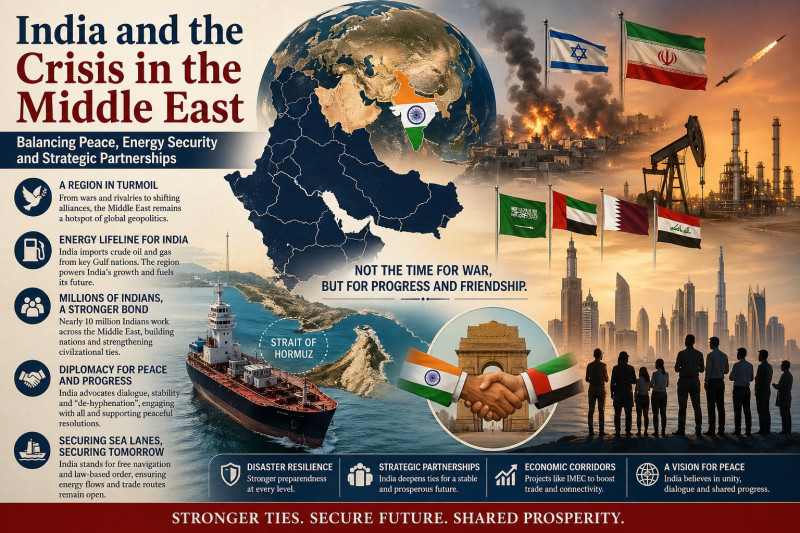
It is said that the relations between India and the Middle East are civilizational. In modern times, energy security has been a significant determinant of relations of India with the countries of Middle East. Nearly fifth part of the global energy supply passes through the region. India imports crude oil and gas from Iran, UAE, Saudi Arabia, Iraq and Quatar. Quatar is the country having world’s third largest gas reserves. India signed a big deal with the Quatar to supply long term LNG (Liquefied Natural Gas). Besides, the Middle East is also a major supplier of chemical fertilizers. These fertilizers are the tonic to India’s vast agrarian land. It is believed that if the supply of chemical fertilizers is disrupted, there would be approximately twenty percent fall of food production in South Asia. This can further interrupt the global food prices.
On 28 February, the Middle East witnessed another spell of volatility with the US-Israel Attack on Iran. These attacks were carried out when the talks for finding the solution were in progress. The region has been at the centre of global politics during and after the cold war. In the meantime, there has been progress towards détente. Many Arab countries don’t perceive Israel as an existential threat to them. The Abrham Accord was a milestone towards good relations. However, the tension between Israel and Iran changed the epicentre of conflict. India as in earlier developments, advocates the peaceful settlement and durable peace in the region. Before the outbreak of war that dismantled the normalcy in the region, India was deepening its ties with the countries. Indira Gandhi had visited the UAE in 1985. Thereafter PM Modi has made more than half a dozen visits to the UAEalone. India’s trade with Saudi Arabia rose by leaps and bounds and is four times more than that of Pakistan.
During the Modi Government era, there is enormous and constructive developments in the relations with the countries of Middle East. Unlike the cold war era, India appeared more confident in manifestation of the relations with Israel. Unfortunately, US and Israel attacked Iran just after the PM’s visit to Israel. This really does not mean that India is distancing form the policy of de-hyphenation in the context of Israel and Palestine. Prime Minster Modi has been honoured with the highest awards of both Israel and Palestine. This is rare and makes PM Modi as an important global leader. Besides, India criticised the attack on innocent people of Israel and also stands with the peaceful settlement of dispute in the region. One of the major developments in the relations with the Middle East is the India-Middle East- Europe Economic Corridor. Obviously, this project would carry the bond of relationship to new heights.
India gives abundant importance to the maritime security anywhere in the world including the Mediterranean Sea and the Strait of Hormuz. The ongoing standoff in the Strait of Hormuz affects the global supply chain adversely. Despite some uneven developments, India emphasizes free navigation and the law-based operation of this vital strait. The success of India’s policy in the Middle East is of immense value because Indian cargo ships have been passing even during the political and military tension between the US and Iran. It is estimated that ten monstrous ships loaded with crude oil and gas have paved the way to Indian coast through the volatile strait despite upheavals. Unlike severe fuel crisis in the neighbourhood, the country’s fuel supply has been relatively stable. Iran has been cooperative so far in India’s efforts of maintaining the energy security in the country.
The role of Pakistan as a mediator or messenger is being examined critically. There is an opinion that “Pakistan gains diplomatically” by facilitating negotiations. This is not the entire story. The US is interested to use Pakistan as a projectile to exit the Middle East. In fact, Pakistan is the face of US efforts to come out of war on its own terms and conditions. It is very true that Pakistan is not having the geopolitical muscle in the region. Israel manifests that the facilitator is not trustworthy and Iran does also have doubts on the honesty of the Pakistani leadership which is openly acting as puppet. The defence pact and the subsequent sending of its military logistic to Saudi Arab stamps Pakistan as an opportunist only. India’s relative silence indicates the “wait and watch” strategy which is very effective in dealing with the ongoing volatile situation considering long-term national interest as a pivot.
One of the significant stakes of India in the region is its ten million population living there. They, thus, become the largest expatriate workforce of the region. They generally work in the areas of oil and gas, transportation, infrastructure and hospitality. The importance of Indians here can be understood with the fact that the Khaleej Times, a popular newspaper, gives ample of space for stories related to India. Indians have contributed immensely in the growth and development of the Middle East. Countries here are trying to shift from based on hydrocarbon to diverse areas. This has resulted into the strengthening of relations between India and the Middle East. Indian professionals got immense opportunities to be the part of this tectonic transformation in the region.
Prime Minster Modi has denounced war as a tool of destruction on many occasions. He says, “This is not the time of war instead a time to progress and friendship.” India believes ending the war would serve the real purpose. All stakeholders should settle their dispute amicably. However, the tension still goes on specially in the strait of Hormuz giving birth to doubts and dogmatism. India, in the meantime, has redefined her energy dimensions and trying to cope up with the situation as decisive power both at the regional and global levels.
(*The views expressed in this article are writer’s personal views)