
 Dr. Shikha Mishra
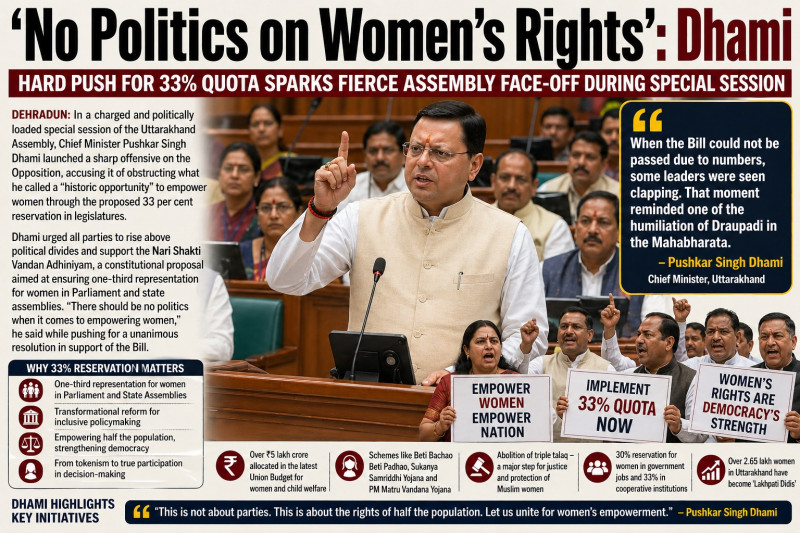
Hard Push By the Gov for 33% Quota Sparks Fierce Assembly Face-off During Special Session
Key Highlights:
- Dhami Pushes 33% Quota: Pushkar Singh Dhami urged unanimous support for the Nari Shakti Vandan Adhiniyam, stressing women’s rights must rise above politics.
- Heated Assembly Showdown: The special session witnessed a fierce face-off as Dhami accused the Opposition of blocking a “historic” reform.
- Strong Political Attack: The CM criticised rival parties for “delaying women’s empowerment” and dismissed concerns over delimitation and seat distribution.
- Session Ends in Uproar: BJP leaders raised slogans against Congress, highlighting deep political divisions over the women’s reservation bill.
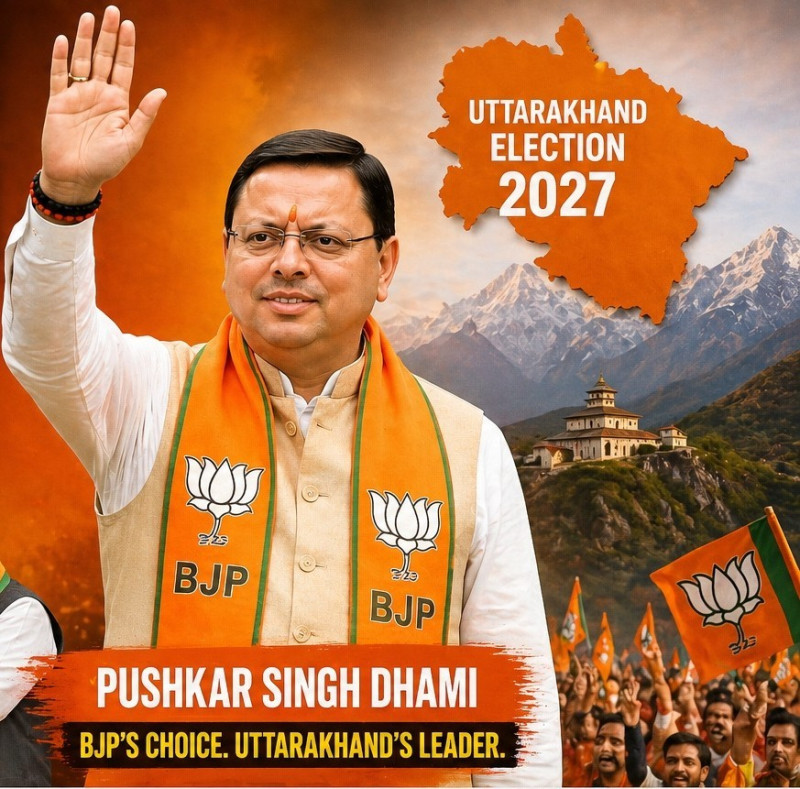
Dehradun: In a charged and politically loaded special session of the Uttarakhand Assembly, Chief Minister Pushkar Singh Dhami launched a sharp offensive on the Opposition, accusing it of obstructing what he called a “historic opportunity” to empower women through the proposed 33 per cent reservation in legislatures.
Addressing the session themed “Nari Samman – Loktantra Mein Adhikar”, Dhami urged all parties to rise above political divides and support the Nari Shakti Vandan Adhiniyam, a constitutional proposal aimed at ensuring one-third representation for women in Parliament and state assemblies. “There should be no politics when it comes to empowering women,” the Chief Minister said, while pushing for a unanimous resolution in support of the Bill.
Chief Minister Pushkar Singh Dhami urged the Uttarakhand Assembly to unanimously support the Centre’s efforts to implement the Nari Shakti Vandan Adhiniyam, stressing that women’s empowerment must rise above politics. He called for collective backing from both ruling and Opposition members, invoking cultural reverence for women as symbols of strength and prosperity.
But the tone quickly turned combative. Dhami directly targeted Opposition parties, accusing them of derailing the Bill despite decades in power. “When the Bill could not be passed due to numbers, some leaders were seen clapping. That moment reminded one of the humiliation of Draupadi in the Mahabharata,” he said—drawing a dramatic and controversial parallel that is likely to intensify political tempers.(box highlight )
The Chief Minister asserted that the Bill is not merely about increasing the number of women legislators but about fundamentally reshaping India’s policymaking structure. “This is not tokenism. This is about giving half the population its rightful place in decision-making,” he said, backing Prime Minister Narendra Modi for bringing what he termed a “transformational reform” in 2023.
He also dismissed Opposition claims regarding delimitation and seat distribution, citing assurances by Union Home Minister Amit Shah that no state would face discrimination. Instead, Dhami accused critics of deliberately spreading confusion to stall the Bill. “Those who ruled for decades never gave women their due. Now when decisive steps are being taken, they are creating hurdles,” he said.
The speech blended political attack with cultural invocation. Dhami began by paying tribute to iconic women figures—from Uttarakhand’s grassroots leaders like Gaura Devi and Tilu Rauteli to national icons such as Rani Lakshmibai and Savitribai Phule—framing the reservation debate within a larger narrative of historical justice.
Backing his claims with data, the Chief Minister highlighted the Centre’s record on women-focused schemes. He said gender budgeting has expanded significantly over the past decade, with over Rs5 lakh crore allocated for women and child welfare in the latest Union Budget. Flagship initiatives such as Beti Bachao, Beti Padhao, Sukanya Samriddhi Yojana, and Pradhan Mantri Matru Vandana Yojana were cited as examples of structural change.
Dhami also pointed to the abolition of triple talaq as a “major corrective step” that, he argued, provided legal protection to Muslim women. He went further, claiming Uttarakhand’s implementation of a Uniform Civil Code has strengthened women’s rights by eliminating practices such as halala, polygamy, and child marriage—remarks that are likely to draw strong reactions beyond the state.
Turning to state-specific gains, Dhami argued that Uttarakhand stood to benefit significantly from the proposed reservation. Post-delimitation, he said, the Assembly’s strength could rise to 105 seats, with 35 potentially reserved for women, while parliamentary representation could also expand. “More representation means more opportunity—not less,” he asserted.
In a pointed political swipe, he added that increased participation of women from ordinary households could disrupt entrenched dynastic politics. “If grassroots women enter politics, some political ‘shops’ will shut down,” he remarked.
The Chief Minister also outlined the state government’s initiatives, including a Rs20,000 crore gender budget, financial support for self-help groups, and schemes aimed at creating “Lakhpati Didis.” He noted that over 2.65 lakh women in Uttarakhand have already crossed this income benchmark. Additionally, the state has implemented 30 per cent reservation for women in government jobs and 33 per cent in cooperative institutions.
Despite the aggressive tone, Dhami ended with a conciliatory appeal, urging the Opposition to adopt a “clear and constructive stand” on women’s reservation. “This is not about parties. This is about the rights of half the population,” he said.
Yet, the session underscored a deeper political reality: even issues framed as social justice are inseparable from electoral strategy. As the debate over women’s reservation intensifies nationally, Uttarakhand’s Assembly has become the latest arena where empowerment and politics collide—loudly, visibly, and unapologetically.
The session ended with BJP leaders raising slogans against the Congress for opposing the bill.