
 L R Bureau
By -Jyotishmoy Baruah
College students navigating the realities of higher education often find themselves questioning whether the system truly serves those it promises to empower. On paper, everything appears structured and progressive, but from within classroom walls, a different picture emerges — one marked by gaps, compromises, and unfulfilled expectations.
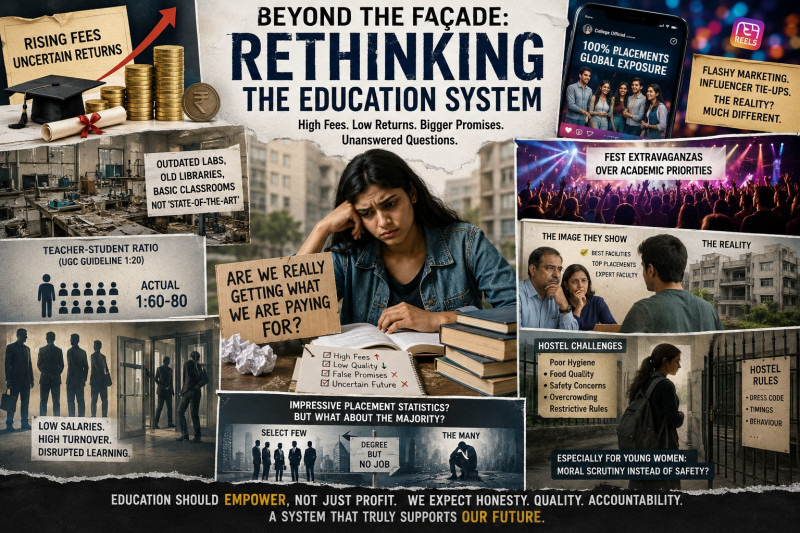
One of the first concerns students encounter is the fee structure. With every academic year, fees continue to rise, often without clear justification. Many students come from middle-class families where education is viewed as a major investment, yet the returns often feel uncertain. When institutions charge high tuition fees, students naturally expect equally high standards in infrastructure and facilities. However, the reality is frequently disappointing. Laboratories often lack proper equipment, libraries remain outdated, and classrooms are sometimes no better than basic lecture halls, contradicting claims of “state-of-the-art” infrastructure. The question students constantly ask is: are we really getting what we are paying for?
Trends across colleges in Dehradun often follow a predictable script: flashy marketing campaigns through Instagram reels and influencer tie-ups promising “100% placements” and “global exposure.” Yet, in many institutions, the teacher-student ratio remains alarmingly high, affecting the quality of individual attention and mentorship available to students. While the article mentions a UGC-mandated ratio of 1:20, it is worth noting that faculty norms vary depending on the institution and programme, and not all colleges uniformly meet recommended standards.
Adding to this is the issue of teacher recruitment. Many institutions hire qualified faculty members at relatively low salaries, which can affect motivation and long-term commitment. In some cases, institutions also struggle with frequent faculty turnover, disrupting continuity in teaching and impacting students’ academic progress. A lack of practical exposure further compounds the problem. Communication gaps exacerbate the situation, as grievances related to syllabus delays, examination schedules, or administrative issues often go unanswered, leaving students frustrated and unheard.
Another growing trend is the culture of “fest extravaganzas.” Colleges increasingly compete over who can organise the grandest festival or celebrity event. These events are heavily marketed to attract admissions for the following academic year, creating the illusion of a glamorous and vibrant college life. While cultural activities are an important part of student engagement, critics argue that institutions sometimes prioritise branding exercises over addressing deeper academic and infrastructural concerns.
Parents, meanwhile, are often shown a carefully curated image during the admission process. Colleges highlight their best facilities, placement records, and faculty achievements. However, the ground reality may not always match these claims. This mismatch affects trust and also places pressure on students, who feel burdened by expectations built on incomplete or exaggerated information.
Hostel life, which should ideally provide a safe and supportive environment, often brings its own challenges. Complaints related to hygiene, food quality, safety, and overcrowding are common in many institutions. Concerns have also been raised in some colleges regarding restrictive hostel rules, particularly for female students. Critics argue that policing students’ clothing choices or imposing gender-based behavioural expectations can create discomfort and reinforce outdated attitudes. Such practices raise an important question: should students, especially young women, continue to face moral scrutiny even within spaces meant to ensure their safety and well-being?
Perhaps the most pressing concern for students nearing graduation is placements. While colleges frequently advertise impressive placement statistics, the opportunities available to the majority of students are often limited. Many graduates struggle to secure jobs aligned with their qualifications and aspirations, while others remain unemployed despite earning degrees. This widening gap between education and employability raises serious questions about the effectiveness of the higher education system.
From a student’s perspective, the problem is not merely about resources but also about priorities. Education should fundamentally focus on learning, critical thinking, personal growth, and preparation for life — rather than becoming a business structure revolving around fees, rankings, marketing, and degrees. Students do not expect perfection, but they do expect honesty, quality, accountability, and a system that genuinely supports their future.