
 Dr. Shikha Mishra
"Toxic Link Between Industrial Chemical Leaks and Ozone Depletion Is Fueling Uttarakhand’s Wildfires "
Relation Between Uttarakhnad Forest fires and Ozone layer Delayed Recovery
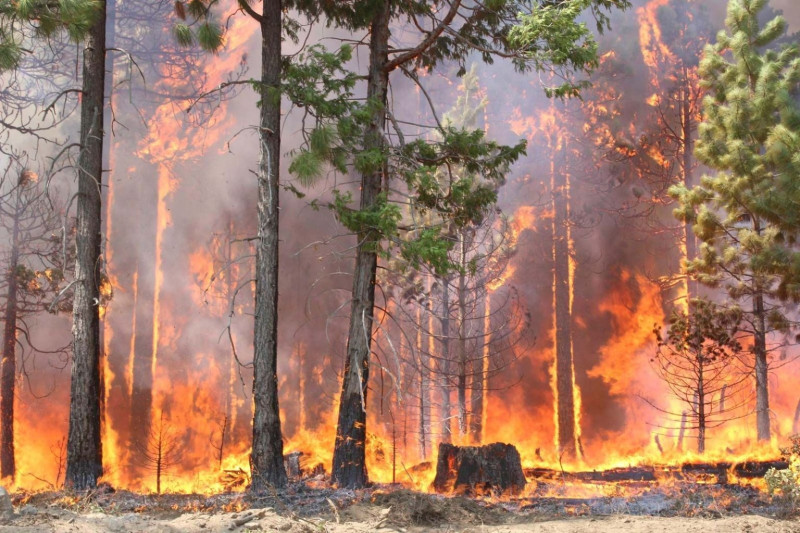
Every summer, the forests of Uttarakhand begin to burn. At first glance, these fires may appear to be a purely local crisis caused by heat, drought, and human negligence. But the deeper scientific reality is far more complex. The story of Uttarakhand’s wildfires is connected to a much larger planetary challenge unfolding high above Earth — the fragile recovery of the ozone layer and the broader disruption of the global climate system.
A new international study published in Nature Communications has warned that hidden industrial emissions are slowing the recovery of the ozone layer by nearly seven years. Researchers from institutions including Massachusetts Institute of Technology, NASA, and NOAA found that ozone-depleting chemicals used as industrial feed stocks are leaking into the atmosphere at far higher levels than previously assumed.
While scientists once believed only 0.5 percent of these chemicals escaped during manufacturing, atmospheric observations now suggest leakage rates closer to 3.6 percent. If these emissions continue unchecked, the ozone layer’s recovery could be delayed until 2073 instead of around 2065.
This revelation is more than a technical environmental setback. It is a reminder that even after decades of progress, humanity’s relationship with the atmosphere remains dangerously fragile.
Profound Consequences Faced by Uttarakhnad
And for regions like Uttarakhand, that fragility carries profound consequences. The ozone layer and Himalayan wildfires may seem unrelated, but they are both symptoms of the same global environmental imbalance. One crisis unfolds in the stratosphere; the other burns across mountain forests. Yet both are linked through climate change, atmospheric warming, and human industrial activity.
The table presented in this article provides a picture of –how Uttarakhand bearing the brunt of this global phenomenon of climatic imbalance triggered by industrial waste consequently causing delay in the recovery ozone layer Depletion leading Uttarakhnad burn.
|
Year / Fire Season |
Estimated Forest Area Burned |
Key Details |
|
2022–23 |
Around 535 sq km (53,500 hectares) affected by fire activity |
Satellite observations recorded a lower fire season compared to the following year. |
|
2023–24 |
Around 1,808.9 sq km (180,890 hectares) impacted |
Fire counts surged dramatically from 5,351 to 21,033 incidents between Nov 2023 and June 2024. |
|
2024 (official incident estimate) |
Approx. 1,145 hectares destroyed in 910 incidents by May 2024 |
Situation reports highlighted severe fires in Pauri and Garhwal regions. |
|
2023 (FSI detailed estimate) |
933.55 hectares |
Central satellite-based assessments reported lower confirmed burn areas than broader fire-impact mapping. |
|
2024 (FSI detailed estimate) |
1,771.665 hectares |
Forest Survey of India data showed a sharp increase over 2023. |
*Data source-Indian Institute of Remote Sensing, The New Indian Express, Drishti IAS, Sphere India,
Ozone Layer as Earth’s Natural Sunscreen
The ozone layer acts as Earth’s natural sunscreen, shielding life from harmful ultraviolet radiation. Its depletion became a global concern in the 1980s after scientists discovered a massive seasonal “hole” above Antarctica caused by chlorofluorocarbons (CFCs) used in refrigeration, aerosols, and industrial applications.
The international response was swift and historic. The Montreal Protocol united nearly every country in the world to phase out ozone-destroying chemicals. It became one of the greatest successes in environmental diplomacy, proving that science-driven policy could reverse planetary damage. But the latest research shows the recovery is slower and more vulnerable than previously believed.
That matters because ozone depletion and climate change are deeply interconnected. Changes in atmospheric chemistry affect temperature patterns, wind circulation, and the balance of heat between different layers of the atmosphere. Meanwhile, many ozone-depleting chemicals are also powerful greenhouse gases that contribute to global warming.
Global warming and Uttarakhand’s increasing Erratic Weather pattern
And it is global warming that is transforming Uttarakhand’s forests into fire-prone landscapes.
Over the past decade, Uttarakhand has experienced increasingly erratic weather patterns — hotter summers, declining pre-monsoon rainfall, extended dry periods, and lower humidity levels. These conditions create ideal environments for forest fires to spread rapidly.
The state’s ecology makes the situation even worse. Large areas are dominated by chir pine forests, whose dry needles ignite easily and act like natural fuel carpets during summer months. Combined with rising temperatures and strong winds, even a small spark — from a cigarette, campfire, or electrical fault — can trigger massive wildfires.
Climate scientists increasingly warn that Himalayan ecosystems are warming faster than many other parts of the world. The mountains that once acted as climatic stabilizers are becoming more vulnerable to heat stress, water scarcity, and ecological degradation.
The Chain-reaction
This is where the connection between atmospheric health and local disaster becomes impossible to ignore.
Global warming is increasingly destabilising the fragile Himalayan ecosystem, making Uttarakhand’s forests hotter, drier, and more vulnerable to devastating wildfires. These fires, in turn, release massive amounts of carbon dioxide, carbon monoxide, nitrogen oxides, and aerosols into the atmosphere, worsening climate change and air pollution. The rising emissions further disturb atmospheric balance and accelerate environmental degradation across the region. In this self-reinforcing chain reaction, industrial pollution fuels planetary warming, warming intensifies forest fires, and the fires themselves pump more greenhouse gases into the atmosphere, deepening the ecological crisis.
For Uttarakhand, this means forest fires cannot be treated merely as seasonal disasters requiring temporary firefighting responses. They are symptoms of deeper climatic shifts demanding structural environmental policy changes.
Protective interventions
The state urgently needs stronger forest management systems, better fire surveillance technology, expanded community awareness programs, and scientific land-use planning. Pine forest management, in particular, requires serious attention. Experts have long suggested large-scale removal or commercial utilization of dry pine needles to reduce combustible material on forest floors.
India’s climate and industrial policies must recognise that atmospheric protection is directly linked to local environmental security. The latest ozone study shows industrial loopholes can delay recovery and worsen long-term climate risks. The success of the Montreal Protocol proves scientific warnings must guide industrial regulation, climate action, and wildfire prevention before ecological damage becomes irreversible.
There is still reason for optimism. The ozone layer is healing, even if more slowly than hoped. Scientific monitoring networks continue detecting hidden environmental threats before they spiral completely out of control. We need to opt for Cleaner industrial technologies, better forest management strategies, and renewable energy systems.
The forests of Uttarakhand and the ozone layer above Earth are connected by a single truth: nature can heal, but only if humanity stops reopening the wounds.
The smoke rising from Himalayan forests and the invisible chemicals leaking into the atmosphere may appear distant from one another. In reality, they are chapters of the same story — a story about the consequences of delayed action, industrial excess, and ecological neglect.(BOX highlight)
And unless that story changes soon, both the mountains below and the skies above will continue paying the price.
(*Disclaimer- Article is written on the basis of reports published by Nature Communications, The New Indian Express, Indian Institute of Remote Sensing and Massachusetts Institute of Technology)