
 Dr. Shikha Mishra
Facade of Fiscal Prudence or Is India Heading Towards Austerity?
Dr Shikhha Mishra
Editor, Lead Reporting (English Weekly)
Ph.D. & M.Phil. in Journalism and Mass Communication
Editorial experience with—The Indian Express, The Pioneer & Hindustan Times
A seasoned journalist, senior media educator and researcher with 19+ years of experience
Author and Patent Holder
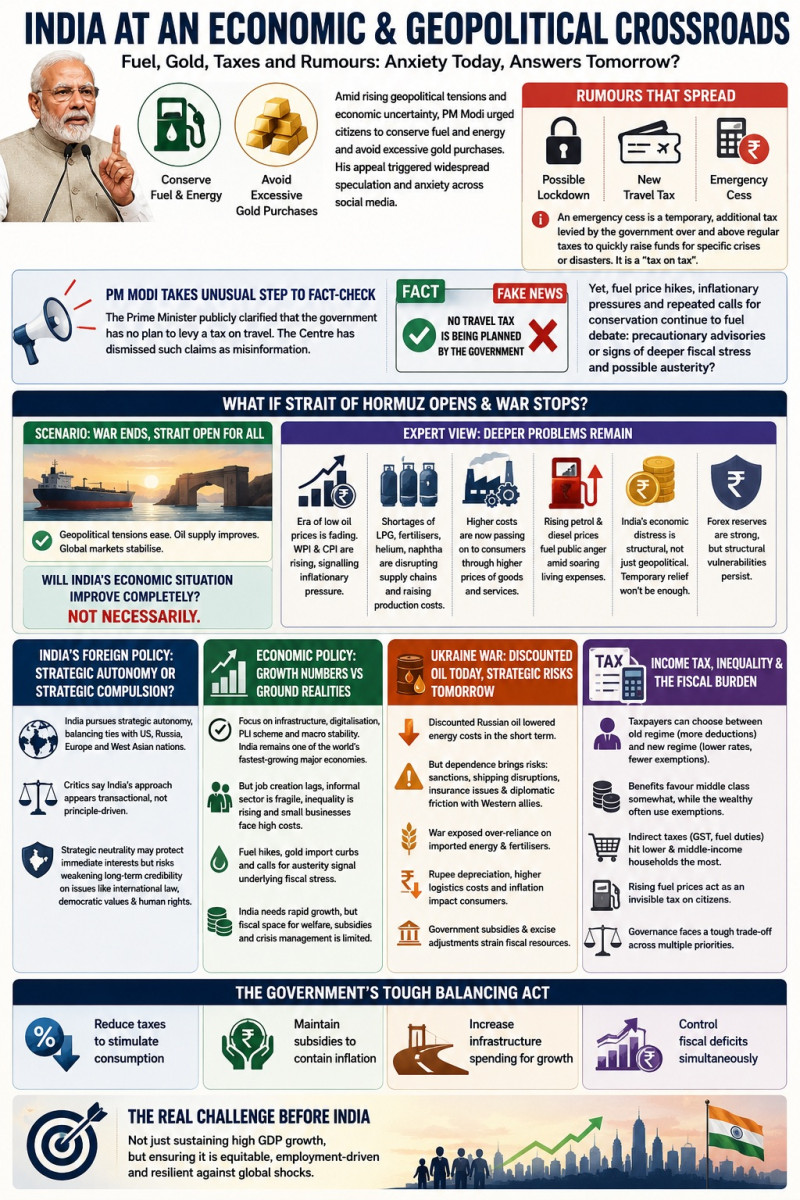
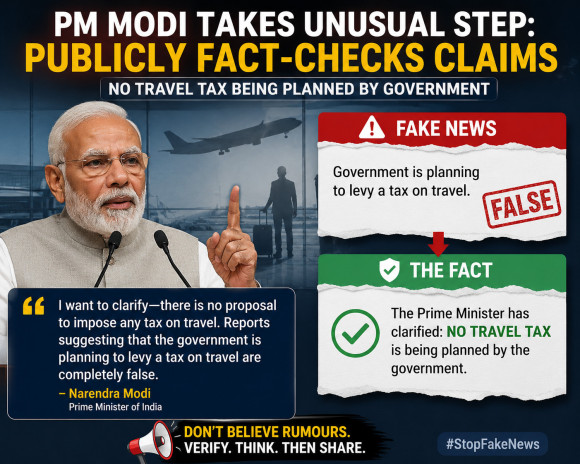
Amid rising geopolitical tensions and mounting economic uncertainty, concerns are growing among Indian citizens after Prime Minister Narendra Modi urged people to conserve fuel and energy while cautioning against excessive gold purchases. The appeal has triggered widespread speculation across social media, with rumours ranging from possible lockdown measures to the imposition of new travel taxes and emergency cesses (An emergency cess is a temporary, additional tax levied by the government over and above regular taxes to quickly raise funds for specific crises or disasters. It is a "tax on tax"). The anxiety intensified to such an extent that the Prime Minister himself took the unusual step of publicly fact-checking reports claiming that the government was preparing to levy a tax on travel. While the Centre has dismissed such claims as misinformation, the combination of fuel price hikes, inflationary pressures, and repeated calls for conservation has fueled a broader public debate over whether these are merely precautionary advisories or early indications of deeper fiscal strain and potential austerity measures in the face of global economic instability.
The question is, what if Strait of Hormuz opens unconditionally for every country and war stops; then this situation could improve or not? Economic experts say that even then India’s economic distress would not simply disappear or turns to normal. Economists warn that the crisis is far deeper and fundamentally structural in nature. While India’s foreign exchange reserves remain relatively strong, the era of low international oil prices that helped contain inflation for nearly a decade is rapidly fading. Rising Wholesale Price Index (WPI) and Consumer Price Index (CPI) figures over recent months already signal mounting inflationary pressure. Simultaneously, shortages of critical commodities such as LPG, fertilisers, helium, and naphtha are disrupting manufacturing supply chains and sharply increasing production costs across industries. These escalating costs are now beginning to filter directly into consumer markets. Adding to public frustration, the government’s decision to raise petrol and diesel prices has intensified anger among citizens already burdened by soaring living expenses, reinforcing fears that temporary geopolitical relief alone cannot resolve India’s deeper economic vulnerabilities.
India undoubtedly today stands at a difficult economic and geopolitical crossroads.
India’s Foreign Policy: Strategic Autonomy or Strategic Compulsion?
Critics argue that India’s foreign policy increasingly appears transactional rather than principle-driven. While strategic neutrality may safeguard immediate national interests, it also risks weakening India’s long-term global credibility on issues such as international law, democratic values, and human rights. We can get bigger picture from the info-graphics given here.
Economic Policy: Growth Numbers vs Ground Realities
India’s economic policy over the last decade has focused heavily on infrastructure spending, digitalisation, manufacturing incentives under the Production Linked Incentive (PLI) scheme, and macroeconomic stability. Officially, India remains one of the world’s fastest-growing major economies.
However, headline GDP growth often conceals deeper structural weaknesses. Employment generation has lagged behind economic expansion, particularly in manufacturing and rural sectors. Informal labour markets remain fragile, while income inequality has widened significantly. Small businesses continue to struggle with high compliance burdens, fluctuating demand, and rising operational costs.
The government’s repeated calls for austerity, combined with fuel hikes and restrictions on gold imports, suggest underlying fiscal stress despite optimistic economic projections. Gold curbs, in particular, reflect concerns over rising imports worsening the current account deficit and pressuring foreign exchange reserves.
The central contradiction remains clear: while India seeks rapid economic expansion, it continues to face limited fiscal space for welfare spending, subsidies, and crisis management during global shocks.
Ukraine War: Discounted Oil Today, Strategic Risks Tomorrow
The Russia–Ukraine war has also had a complex impact on the Indian economy.
Initially, the conflict triggered a sharp rise in global crude oil, fertiliser, and food prices, increasing inflationary pressures and widening India’s import bill. However, India simultaneously benefited from discounted Russian crude oil purchases, helping reduce immediate energy costs.
This short-term advantage, however, masks deeper vulnerabilities.
India’s increasing dependence on Russian energy exposes it to potential secondary sanctions, shipping disruptions, insurance complications, and diplomatic friction with its Western allies. Furthermore, the war highlighted India’s excessive reliance on imported energy and fertilisers, both of which remain highly vulnerable to geopolitical instability.
The conflict also contributed to rupee depreciation, rising logistics costs, and inflation in essential commodities — ultimately affecting ordinary consumers through higher transport costs, food prices, and fuel expenses.
While the government has attempted to shield consumers through excise adjustments and selective subsidies, such interventions place additional pressure on already stretched fiscal resources.
Income Tax Slabs, Inequality, and the Fiscal Burden
India’s evolving income tax structure reflects an attempt to simplify taxation while boosting consumption. The government now offers taxpayers a choice between the old regime — with higher tax rates but multiple deductions — and the new regime, which offers lower nominal rates but fewer exemptions.
While this optional system increases flexibility, its actual redistributive impact remains debatable.
Middle-class salaried taxpayers may benefit from lower rates and standard deductions, but wealthier individuals often continue to exploit exemptions and investment-linked benefits under the old regime. Meanwhile, indirect taxes such as GST and fuel duties continue to place disproportionate burdens on lower and middle-income households.
Critics argue that India’s taxation structure increasingly relies on indirect taxation rather than progressive direct taxation. As fuel prices rise, transportation and essential goods become costlier, effectively functioning as an invisible tax on ordinary citizens.
The government thus faces a difficult balancing act and there few suggestions-
- reduce taxes to stimulate consumption,
- maintain subsidies to contain inflation,
- increase infrastructure spending for growth,
- simultaneously control fiscal deficits.
The real challenge before India is not merely sustaining high GDP growth, but ensuring that growth remains equitable, employment-driven, and resilient against global disruptions.