
 Dr. Shikha Mishra
UN Flags Disturbing Rise in Digital Abuse of Women Journalists

The internet was once celebrated as a revolutionary democratic space — a platform capable of amplifying unheard voices, dismantling traditional hierarchies, and empowering marginalised communities across the globe. Yet, in the age of artificial intelligence, the digital sphere is increasingly becoming a hostile battlefield for women, especially those who dare to speak publicly, challenge authority, or occupy spaces of influence. The latest UN Women report, Tipping Point: Online Violence Impacts, Manifestations and Redress in the AI Age, paints a deeply disturbing picture of how technology is being weaponised against women in public life.
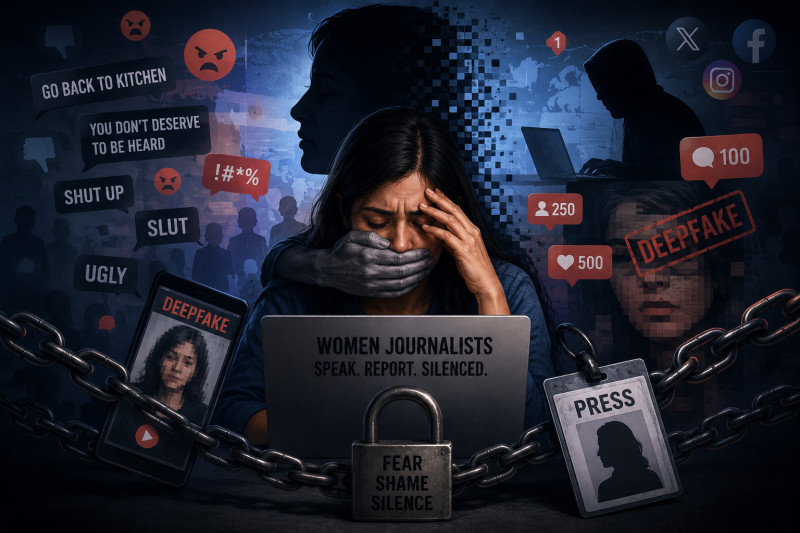
The UN report warns that online violence against women is becoming a direct threat to democratic participation. Around 12 per cent of women journalists, activists, and public communicators have faced non-consensual image sharing, while six per cent were targeted by AI-generated deepfakes. Nearly one in three women received unsolicited sexual messages, reflecting a coordinated attempt to intimidate and silence female voices online.
What makes this crisis particularly alarming is the transformation of online abuse from sporadic trolling into organised digital violence. The report clearly indicates that these attacks are often deliberate, strategic, and politically motivated. Women, who challenge misogyny, expose corruption, defend human rights, or simply express independent opinions online increasingly face targeted harassment campaigns aimed at destroying their credibility and emotional well-being.
The consequences extend far beyond emotional discomfort. Nearly 41 per cent of women surveyed admitted to self-censoring on social media to avoid abuse, while 19 per cent reported censoring themselves professionally because of online violence. Among women journalists and media workers, the figures are even more chilling. Almost half of them now avoid expressing opinions online out of fear, representing a dramatic increase over the past five years.
This trend represents a dangerous assault on freedom of expression and democratic discourse. When women journalists begin to silence themselves, society loses not only diverse perspectives but also critical scrutiny of power structures. Democracies depend upon fearless public participation, yet digital misogyny is systematically pushing women out of the public sphere.
Artificial intelligence has intensified this threat in unprecedented ways. Deepfake technology, once viewed as a futuristic novelty, has rapidly evolved into a tool of humiliation and coercion. AI-generated explicit content can now fabricate compromising videos or images within minutes, often without the victim’s knowledge or consent. For women in public life, the damage is immediate and devastating. Careers can be destroyed overnight, reputations permanently tarnished, and mental health irreparably harmed.
What makes deepfakes particularly insidious is that they exploit a society already conditioned to scrutinise women more harshly than men. Female journalists, politicians, actors, and activists frequently face judgment not merely for their work, but for their appearance, personal lives, and morality. AI-powered abuse amplifies these prejudices by creating false yet believable content that spreads faster than truth itself.
The psychological toll outlined in the UN report is equally alarming. Nearly one in four women journalists surveyed reported being diagnosed with anxiety or depression linked directly to online violence, while almost 13 per cent said they had been diagnosed with post-traumatic stress disorder. These are not isolated emotional reactions; they are symptoms of a larger systemic failure to protect women in digital spaces.
Perhaps the most troubling aspect of the report is that the world remains dangerously unprepared to address this crisis. According to World Bank findings cited in the report, fewer than 40 per cent of countries possess laws specifically protecting women from cyber harassment or cyberstalking. Consequently, approximately 1.8 billion women and girls globally remain without adequate legal safeguards against online abuse.
This legal vacuum reveals a painful contradiction of the digital age: technology has advanced at extraordinary speed, but laws, institutions, and ethical frameworks have failed to keep pace. Governments across the world continue to treat online violence as a secondary issue — an unfortunate by-product of social media rather than a direct attack on human rights and democratic participation.
Technology companies face growing criticism for failing to curb online abuse despite repeated promises of safer digital platforms. Algorithms often amplify outrage and harassment because controversial content drives engagement and revenue. Women from the Global South remain particularly vulnerable, as moderation systems frequently fail to detect region-specific abuse, misogynistic language, and culturally coded threats, leaving victims isolated and unprotected.
The internet did not invent sexism; it merely accelerated and magnified prejudices already embedded within social structures. Online abuse thrives because many societies continue to normalise the policing of women’s voices, appearances, ambitions, and autonomy.
The rise of digital violence against women also reflects a broader global trend of democratic backsliding and political polarisation. Across many countries, women journalists, activists, and public intellectuals are increasingly targeted not only because of gender, but because authoritarian tendencies often view independent female voices as threats to established power structures. Online intimidation thus becomes a political weapon as much as a social one.
Yet despite the grim reality, there are signs of resistance. The UN report notes a growing willingness among women journalists and media workers to report abuse to law enforcement and pursue legal action against perpetrators. This shift reflects increasing awareness that online violence is not trivial or inevitable — it is criminal, harmful, and politically consequential.
Awareness alone cannot end online violence against women. Governments must strengthen cyber harassment and deepfake laws, while technology companies redesign systems that reward abuse and misinformation. Experts warn that silencing women through intimidation weakens democratic discourse itself. A society where women fear speaking freely online is not only digitally unsafe, but fundamentally democratically diminished.
The UN report’s title, Tipping Point, is therefore deeply symbolic. The world now stands at a decisive moment. Either governments, institutions, and citizens act collectively to reclaim digital spaces as arenas of equality and free expression, or the internet risks becoming the most sophisticated instrument of gendered silencing in modern history.