
 Dr. Shikha Mishra
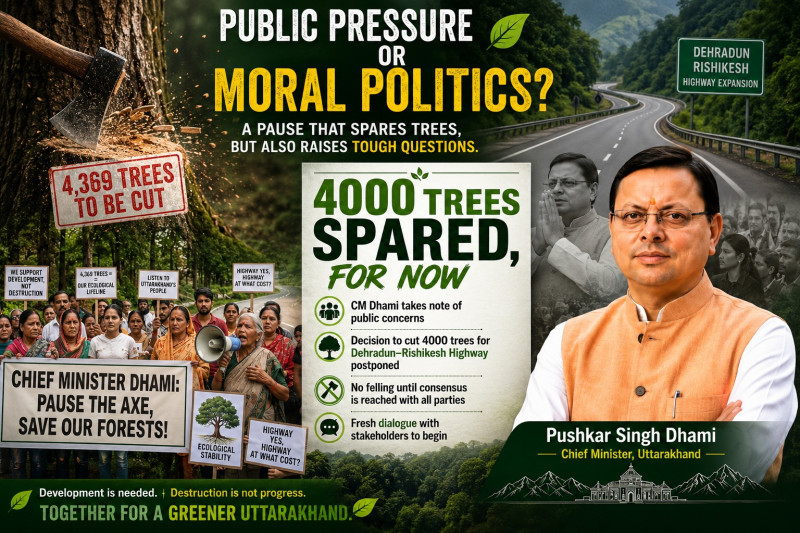
Public Pressure or Moral Politics?
CM Dhami’s Tree Halt: A Welcome Pause, but Also a Warning
Dr Shikhha Mishra
Editor, Lead Reporting (English Weekly)
Ph.D. & M.Phil. in Journalism and Mass Communication
Editorial experience with—The Indian Express, The Pioneer & Hindustan Times
A seasoned journalist, senior media educator, Media & Communication Researcher
Author and Patent Holder
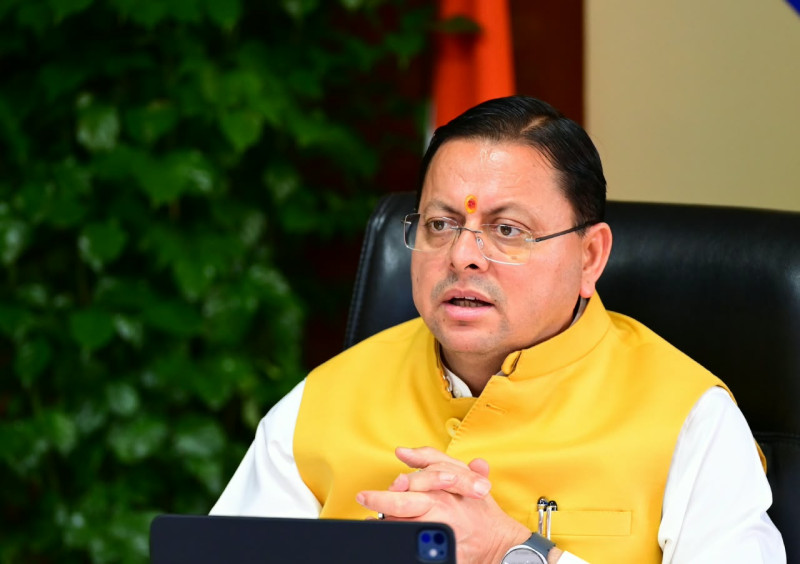
Although Chief Minister Pushkar Singh Dhami has consistently responded to the needs of the people, the Dehradun–Rishikesh Highway project has placed him in a difficult position. His personal phone calls and visits to the victims of various calamities and to those in need are among the finest examples of his commitment to public service, undoubtedly giving him an edge over many other politicians. Yet the question remains: Why did the situation escalate to this extent? Why was such widespread public outcry necessary to draw the State Government's attention to an environmentally sensitive state like Uttarakhand?
Moreover the decision to halt the felling of 4,369 trees for the Dehradun–Rishikesh highway expansion is a politically wise move and a morally necessary one. It shows responsiveness to public sentiment and environmental anxiety, but it also raises a harder question: why did a project of such ecological consequence reach this stage before the government stepped back?
Public anger forced a rethink
The immediate trigger for the rollback was unmistakable public resistance. Residents, environmental activists, and local groups objected to the large-scale cutting of trees, especially in a fragile Himalayan region where forest cover is not a decorative issue but a core part of ecological stability. The protest did not emerge from sentimentality alone; it reflected fear of losing mature trees, wildlife movement routes, and the environmental balance that keeps such regions livable.
That is why the government’s pause matters. It signals that the administration has not entirely lost its ability to listen. In an age when governments often confuse speed with strength, Dhami’s halt shows a degree of restraint.
The critical question: why was this approved at all?
The most potent characteristic of a strong democracy is that the citizens are allowed to raise question and demand accountability from the government. So the people of Uttarakhand are free to ask that how did the proposal advance so far? If a project involves cutting thousands of trees in an environmentally sensitive corridor, then consultation cannot be an afterthought. It must begin at the planning stage, not after public outrage has already broken out.
This is where the Dhami government deserves criticism. A development project may be legally processed and technically justified, but that does not automatically make it wise. In Uttarakhand, where fragile slopes, forests, and wildlife corridors are part of daily reality, governance must be more imaginative than simply widening roads and calling it progress. Development that ignores ecological cost is not development in any meaningful sense; it is short-term convenience disguised as public interest.
The strength in Dhami’s response
Yet it would be unfair to ignore the fact that Dhami did not persist stubbornly once the backlash became clear. He halted the tree felling, called for broader consultation, and appeared to recognise that public trust matters as much as engineering plans. That is not a minor point. In politics, leaders are often judged not only by the decisions they make, but by their willingness to correct course when reality changes.
This is also consistent with the image Dhami has tried to build: a chief minister who wants to appear accessible, responsive, and attentive to public mood. His government has projected itself as active on governance, recruitment reforms, welfare measures, and plantation drives. Those are not trivial achievements, and they explain why many supporters still see him as a serious administrator rather than a symbolic politician.
Green image versus green reality
But image is not enough. A government cannot claim environmental sensitivity on one hand and approve mass tree-cutting on the other without inviting charges of contradiction. Planting saplings is useful, but it is not a substitute for mature trees. A newly planted tree cannot instantly replace the shade, soil retention, biodiversity support, and carbon value of an old one.
That is the real weakness in the state’s position. Infrastructure planners often speak as if afforestation can simply compensate for ecological loss. In practice, compensation is slow, uncertain, and often inadequate. If the forest is cut today, the ecological damage is immediate. If saplings survive at all, the benefits may take years to emerge. The time gap itself is part of the harm.
A government must anticipate, not react
The larger lesson from this episode is that good governance should anticipate conflict before it becomes confrontation. If public outrage is the final stage of consultation, then consultation has failed. In Uttarakhand, this failure is especially costly because the state cannot afford repeated battles between road-building and forest preservation.
The government now has a chance to do better. It should not merely suspend the cutting and wait for the news cycle to move on. It should make the project’s environmental logic transparent, examine alternative alignments, publish ecological assessments in plain language, and ensure that local communities are involved in the decision-making process from the beginning. Anything less would mean repeating the same mistake with a different headline.
A fair verdict
Dhami deserves credit for halting the felling and respecting public concern. That was the right decision, and it prevented a damaging mistake from becoming irreversible. But the deeper criticism remains: the state should never have needed a public revolt to pause such a large ecological intervention.
So the final judgment must be balanced. This was a moment of political sensitivity from Dhami, but also a moment of administrative embarrassment. It was a victory for citizens who defended their forests, and a reminder to the government that in a Himalayan state, development must be measured not only in roads built, but in trees spared, ecosystems preserved, and trust maintained.