
 LR Bureau
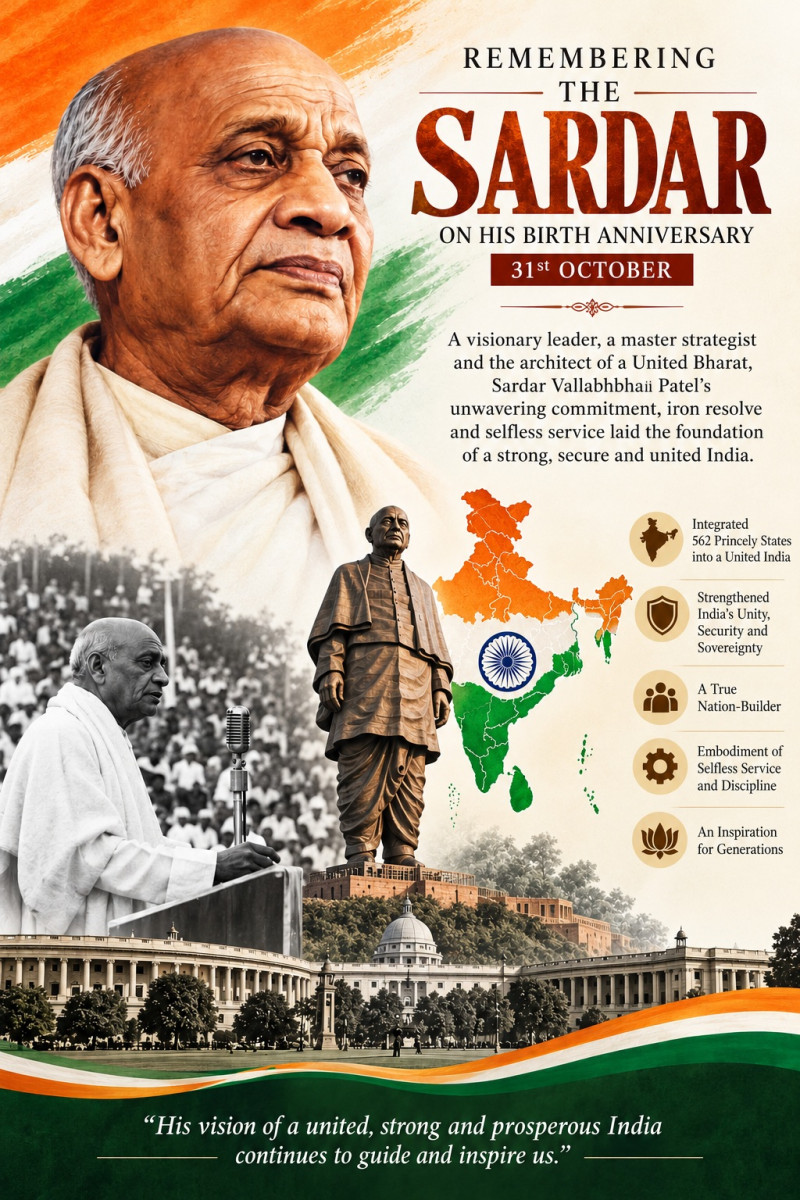
Sardar Patel Birth Anniversary Special

Professor Dr. Ravindra Kumar ( Awarded Padma Shri)
Former Vice Chancellor, CCS University, Meerut;
Ombudsman/ Professor Chair Swami Vivekananda Research Centre
Swami Vivekanand Subharti University, Meerut;
Advisor, Business Economics, Kolkata, India
ravindrwpmt@gmail.com; ravindrakumar5@hotmail.com
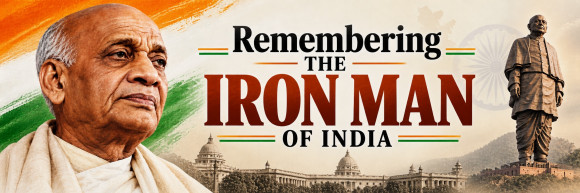
India’s Interim Government was formed on September 2, 1946 AD, under the leadership of Pandit Jawaharlal Nehru, who had succeeded Maulana Azad as the Congress President. Although Sardar Patel was the most influential leader within the Congress organization at the time—and had, in fact, received overwhelming support from provincial Congress committees across the country to become the party President (in place of Nehru) prior to the formation of the Interim Government—it was Nehru who became the Congress president and, in that capacity, the Prime Minister of the country in the Interim Government. This historic sequence of events remains a subject of discussion to this day, with some even arguing that an injustice was done to Sardar Vallabhbhai Patel. The topic occasionally gains prominence in political circles. Therefore, on the occasion of Sardar Patel’s birth anniversary (October 31st), it is appropriate to shed light on those events from eighty years ago, focusing on the historical facts.
Following Maulana Azad’s tenure, the selection of a new Congress President was the most critical issue for the party, as elections to the Central and provincial legislatures had already taken place by that time. Meanwhile, with the arrival of the Cabinet Mission and the subsequent discussions between its members (Pethick-Lawrence, Stafford Cripps, and A. V. Alexander) and national leaders, India was moving towards independence.
In such a context, the role—and consequently the responsibilities—of the President of the Congress, the country’s largest political organization, were set to expand significantly. Although Maulana Azad himself wished to continue as the Congress President. The political developments, circumstances, and prevailing atmosphere in the country at that time, however, made this impossible.Consequently, in keeping with tradition, the provincial Congress committees were asked to suggest names for the next Congress President. Out of a total of fifteen provincial Congress committees, twelve proposed the name of Sardar Vallabhbhai Patel. Not a single provincial Congress committee recommended the name of Pandit Jawaharlal Nehru. However, even before this became public knowledge, Mahatma Gandhi had already expressed his wish—in a letter written to Azad himself on April 20, 1946 AD—that Pandit Jawaharlal Nehru should be the next Congress President.
During a meeting of the Congress Working Committee held in Delhi, it was revealed that twelve out of the fifteen provincial committees had recommended Sardar Patel for the position. At the same meeting, Acharya J. B. Kripalani, in his capacity as the General Secretary of the party, took the initiative to circulate a document proposing Nehru’s name for the Congress Presidency, inviting the members of the Working Committee and some members of the All-India Congress Committee present there to sign it. Everyone signed it, and Sardar Patel also affixed his signature.
Mahatma Gandhi pointed out to Nehru that, apart from the members of the Working Committee, no provincial Congress Committee had proposed his name. Nehru remained silent. Ultimately, he became the Congress President. Consequently, despite the resolutions from the provincial Congress committees in his favour, Sardar Patel did not become President, and Nehru took the party’s top post without the support of a single provincial committee.
Why? To this day, many of our countrymen consider that episode both inappropriate and imprudent—as if everything had been pre-planned. At the time, Dr. Rajendra Prasad remarked that Gandhiji had sacrificed a trusted colleague for the sake of the charismatic Nehru. It is also a historical fact that many prominent figures within the Congress organization—all of whom held nationalist leanings—were strongly opposed to Sardar Patel’s decision in 1946 AD to step aside in favour of Nehru for the Congress presidency, even though Patel commanded an overwhelming majority of support within the party's provincial committees.
Out of deep respect for Sardar Patel, they chose to remain silent regarding his decision. However, the manner in which Nehru, upon becoming Congress president, formed his Working Committee—while blatantly sidelining the nationalists—came as a profound shock to the dedicated Congressmen. Dwarka Prasad Mishra (a prominent Congress leader from the Central Provinces, who later also served as the Chief Minister of Madhya Pradesh twice between 1963 and 1967 AD), wrote to Sardar Patel, expressing his reproach to him, “It seems to me today that we have been foolish in obeying you and remaining mute. We have been made to surrender without a fight! All of us are not job-hunters. We too have some (nationalist-centered) political ideals and we wish to see them realized. Our silence should not be mistaken for absence of an active brains and warm hearts…” (V. Shankar, Sardar Patel’s Correspondence, Vol. 2, Page 509)
It is also a historical fact—one that the present generation should be aware of—that Sardar Patel himself felt deeply aggrieved by the marginalization of nationalist Congress leaders (who had dedicated their entire lives to the cause) within the Working Committee after Nehru assumed the Presidency of the party in 1946 AD. For this reason, at one point, Sardar Patel even considered separating himself from the Congress Working Committee under Nehru.(V. Shankar, Sardar Patel’s Correspondence, Vol. 2, Page 511)
Much has been said and written on this subject, and the discourse continues to this day, as mentioned already. About forty years ago, while conducting my Ph.D. research, I met Maniben—Sardar Patel’s daughter—several times at the Sardar Vallabhbhai Memorial Bhavan in Ahmedabad. I conducted multiple interviews with her, during which I asked about this particular matter. She shared several startling details with me under certain conditions, so I will not go into the specifics here.However, she did explain that Sardar Patel chose to cede the position of Congress President to Nehru to ensure that no rift or fragmentation would occur within the Congress party as the nation approached the threshold of independence—a move intended to prevent any harm whatsoever to the country.
Under the framework established for the nation’s Interim Government, as mentioned earlier, the individual holding the Congress Presidency was slated to become the Vice-President of the Executive Council—a role equivalent to that of Prime Minister—while the Viceroy served as the Councils President. It was in this capacity that Pandit Nehru assumed leadership.
Following India’s independence, Sardar Patel served as the Deputy Prime Minister and Home Minister; his contributions to the nation were—and remain—unprecedented. He was the embodiment of self-sacrifice, with the nation always remaining his highest priority. He used to say that the thought of holding any particular office or position never even crossed his mind; he believed that wherever he happened to be, he would simply continue to perform his share of the work—in accordance with the will of God—for as long as He desired.
Sardar Patel did not become India’s Prime Minister in the Interim Government; yet, by realizing the vision of ‘a United Bharat’ and forging the greatest possible India—as evidenced by the entirety of available history—he proved himself to be a true and matchless nation-builder.