
 Dr. Shikha Mishra
Commission Plans DistrictWide Outreach From land disputes to scholarships and caste discrimination, ensuring faster justice and greater access to welfare for Scheduled Caste communities
Lead Reporting
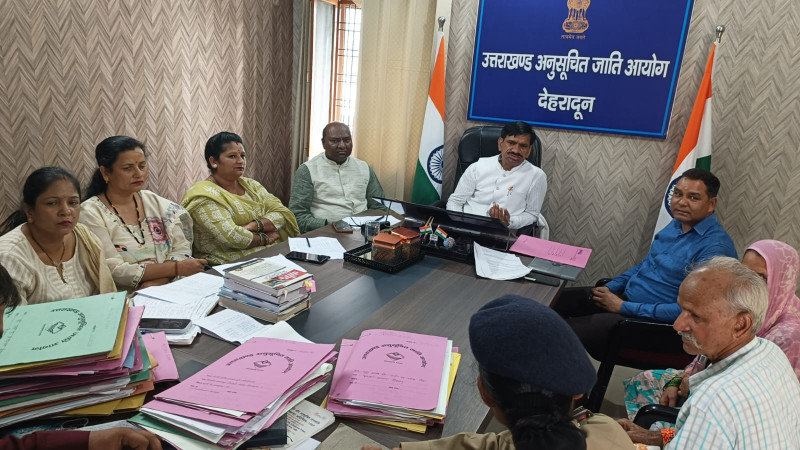
Dehradun: For many citizens, justice begins with being heard. On Friday, the Uttarakhand Scheduled Caste Commission sought to reinforce that principle by addressing dozens of grievances from across the state during a twoday public hearing, while announcing plans to take the justice delivery mechanism directly to districts through largescale outreach camps.
The public hearing, chaired by Mukesh Kumar, Chairman of the Uttarakhand Scheduled Caste Commission, was held at the Commission's office in Dharampur Danda, Dehradun. Of the 47 cases taken up during the proceedings, 27 were resolved on the spot, while directions were issued to the concerned authorities for the timely disposal of the remaining matters.
The hearing drew complainants from Dehradun, Haridwar, Udham Singh Nagar, Pauri, Tehri, Uttarkashi, Chamoli, Nainital, Rudraprayag and several other districts, reflecting the wide range of challenges faced by Scheduled Caste communities across Uttarakhand.
The grievances extended far beyond individual disputes, revealing recurring issues related to access to basic services, land rights, employment and social justice. Cases included denial of drinking water connections, illegal encroachments on land, pending land measurements, delayed scholarship payments, castebased discrimination, harassment, restoration of government services, promotions, regularisation of land records, compassionate appointment certificates, and concerns over outsourced employees.
Addressing the gathering, Chairman Mukesh Kumar said the Commission's foremost responsibility is to ensure that every person approaching it with hope receives fair and timely justice.
"A victim approaches the Commission with faith that justice will be delivered. Fulfilling that trust is our primary objective," he said.
In a significant announcement, Kumar said the Commission would organise largescale grievance redressal camps across districts, enabling people to resolve their complaints closer to home while simultaneously improving access to government welfare schemes.
The proposed districtlevel camps are expected to reduce the burden on complainants who often travel long distances to seek redress, particularly those from remote and hilly regions of Uttarakhand. The initiative also aims to bridge the gap between citizens and government services by combining grievance resolution with awareness and access to welfare programmes.
The Chairman stressed that the presence of competent departmental officers during hearings significantly speeds up the resolution process and urged government officials to discharge their responsibilities diligently so that citizens need not approach the Commission for issues that should be resolved through routine administrative processes.
"Every officer must work within the framework of law and discharge their duties responsibly. Effective governance at the departmental level can prevent unnecessary hardship for citizens," he said.
The Commission views public hearings not merely as a legal exercise but as a platform to strengthen accountability and ensure that the constitutional rights of Scheduled Caste communities are protected through responsive governance.
Commission members Vishal Mukhiya, Bhagirathi Kunjwal and Sunita Devi, Secretary Kavita Tamta, Legal Adviser Raju Mehar, Tirpan Singh and other officials were present during the proceedings.
As the Commission prepares to expand its outreach beyond the state capital, the initiative signals a broader effort to make justice more accessible, responsive and inclusive—particularly for communities that have historically faced barriers in accessing public services and institutional support.