
 Dr. Shikha Mishra
Dhami steps up grassroots mobilisation, urges daily worker meetings and sharper delivery of government schemes across Uttarakhand
Lead Reporting
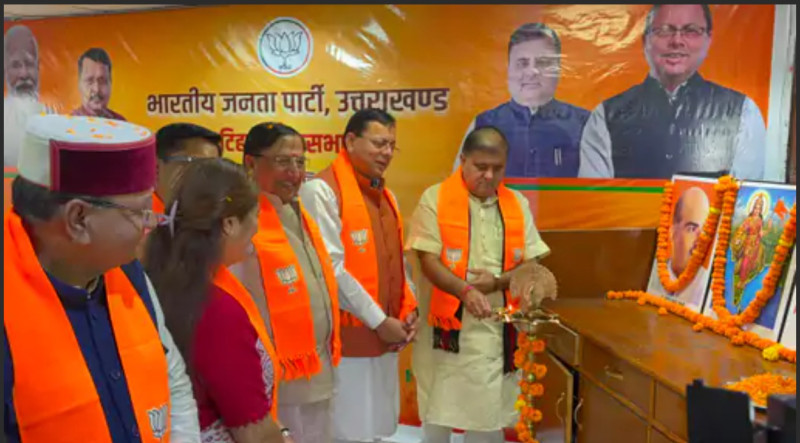
Dehradun: With the 2027 Uttarakhand Assembly elections still over a year away, the Bharatiya Janata Party (BJP) has already shifted into high gear, launching a comprehensive organisational overhaul aimed at fortifying its booth-level machinery and tightening the feedback loop between the government and the grassroots. The strategy, unveiled during a high-level review meeting at the party’s state headquarters on Tuesday, signals a clear intent: to convert administrative performance into electoral capital long before the formal campaign season begins.
Chief Minister Pushkar Singh Dhami, who presided over the meeting, emphasised that the party’s greatest asset remains its cadre and organisational depth. He directed MPs, MLAs, district presidents, and senior office-bearers to ensure that every booth in the state has active worker participation, warning against a top-heavy structure where activity is confined to leadership levels.
Booth-Level Organisation Takes Centre Stage
At the heart of the BJP’s new strategy is a renewed focus on booth-level management. Dhami instructed elected representatives and organisational leaders to hold frequent meetings with workers, ensuring continuous engagement rather than sporadic contact during election season.
The Chief Minister stressed the importance of a two-way communication channel, officers must not only disseminate information about government schemes but also relay local grievances and suggestions back to the government through the party’s organisational network. This approach seeks to transform the BJP’s grassroots workers into both messengers of policy and listeners of public sentiment, effectively embedding the party deeper into the daily lives of voters.
Government Schemes to Reach the Electoral Ground
A significant portion of the meeting was dedicated to discussing how welfare schemes and development projects could be better communicated at the grassroots level. Dhami urged party workers to ensure that the benefits of government initiatives reach the “last person in society” and that citizens are fully aware of the schemes available to them.
For the BJP, this is not merely about administrative efficiency but about building a sustained public-contact mechanism. By ensuring that government performance is discussed at the booth and neighbourhood level—where voters interact directly with party workers—the party aims to make its governance record a central theme of the 2027 electoral contest.
Three Lok Sabha Regions Under Review
The first phase of this organisational exercise covers the Pauri Garhwal, Tehri Garhwal, and Haridwar Lok Sabha regions. These three areas present diverse geographical and political dynamics, encompassing hill, plain, and mixed constituencies.
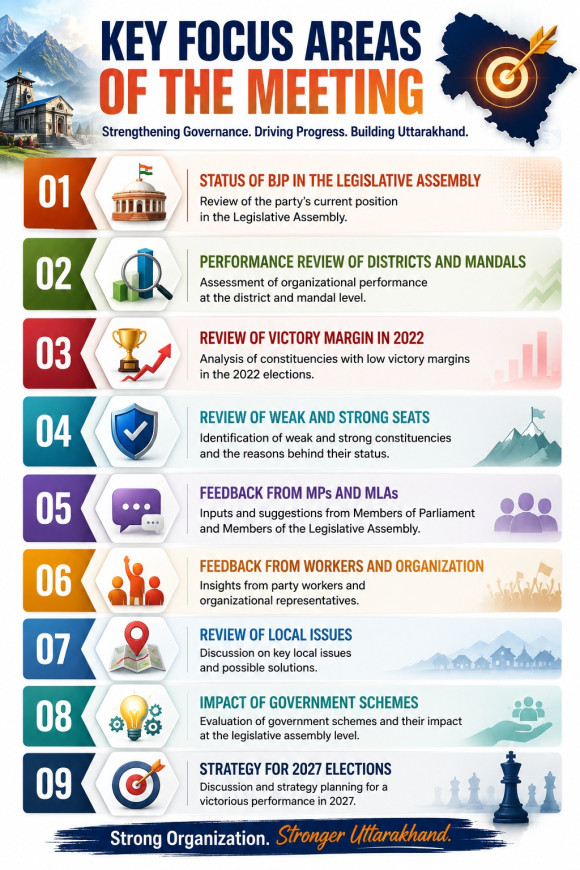
The BJP leadership is expected to tailor its strategy to the specific political circumstances of each region rather than adopting a one-size-fits-all approach. Discussions focused on identifying where the organisation is strong, where worker activity needs to be increased, which booths require greater attention, and what local issues could influence the electoral contest.
This exercise also provides an opportunity for party leaders to receive direct feedback from elected representatives and organisational functionaries about conditions on the ground, allowing for a more nuanced understanding of local political realities.
From Identifying Weaknesses to Corrective Action
The significance of the BJP’s organisational review lies in its timing. By beginning the exercise well before the election campaign officially begins, the party is giving itself several months to address organisational gaps and strengthen its grassroots structure.
The discussions are not limited to identifying weaknesses but also focus on determining how such weaknesses can be addressed and how responsibility for corrective action can be distributed. If implemented effectively, this could result in targeted efforts at the Assembly and booth levels, with local leaders expected to strengthen areas where the organisation remains comparatively weak.
Lessons from the 2022 Assembly Election
The BJP’s preparations for 2027 are also likely to draw on its experience in the 2022 Uttarakhand Assembly election, when the party returned to power for a second consecutive term. Although the BJP secured a mandate, several constituencies witnessed close contests, providing valuable lessons for the party as it prepares for the next election.
The organisation is expected to pay particular attention to seats where the winning margin was narrow or where the party encountered significant local challenges. A booth-wise and constituency-wise assessment of the previous election could help the BJP determine where greater worker mobilisation, voter contact, and organisational attention may be required.
Linking Beneficiaries with the Organisation
Another important element of the BJP’s approach is the proposed connection between government welfare delivery and the party’s grassroots network. The leadership is expected to examine how effectively government schemes are reaching different sections of society and whether beneficiaries are being adequately informed about them.
The party’s organisational network can play a significant role in communicating information about welfare initiatives while simultaneously collecting feedback about implementation at the local level. This could allow the BJP to convert government schemes into a more direct people-to-organisation connection, particularly in areas where voters’ political choices are strongly influenced by local delivery and accessibility of public programmes.
A Strategy Extending Beyond Three Region
The organisational exercise is expected to expand to other Lok Sabha regions of Uttarakhand as the BJP continues its preparations for the 2027 Assembly elections. The broader objective is to create a coordinated structure running from the Lok Sabha and Assembly levels through mandals and down to individual booths.
Such a structure would allow the party to monitor political developments at the constituency level while keeping its grassroots workers engaged throughout the pre-election period. For a state with diverse geographical and social characteristics, this localised approach could become particularly important, as political priorities in the hill districts may differ considerably from those in the plains.
The Long Game for 2027
Tuesday’s meeting was important not simply because of the issues discussed but because of the timing of the exercise. The BJP has chosen to begin its detailed organisational preparation well ahead of the election, giving itself time to strengthen weak areas, improve coordination, and establish sustained contact with voters.
The challenge now will be to maintain this momentum. Regular meetings with workers, consistent public engagement, and effective communication of government schemes will need to continue long after the initial organisational meetings conclude.
For Chief Minister Dhami and the Uttarakhand BJP, the emerging strategy rests on three key pillars: stronger booth-level organisation, continuous engagement with workers, and effective communication of government performance. The real test, however, will come when this organisational machinery meets the electorate. Turning meetings and plans into sustained grassroots activity—and ultimately converting that activity into voter confidence—will determine how effective the BJP’s early preparation proves to be when Uttarakhand votes in 2027.