
 Dr. Shikha Mishra
- 1.75 lakh students across 1,100+ government schools join statewide cyber-awareness dialogue;
- police to make cyber security, drug awareness and road safety sessions a regular feature in schools
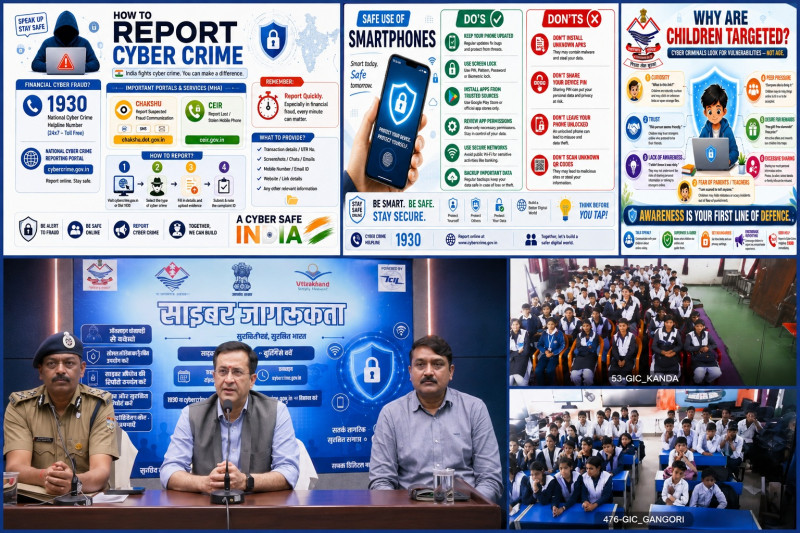
Dehradun: In a significant youth-focused initiative aimed at building a generation of digitally responsible citizens, the Uttarakhand Police on Thursday connected with nearly 1.75 lakh students from more than 1,100 government schools across the state through a statewide virtual cyber-awareness programme.
Held under the Prime Minister’s digital security message and Chief Minister Pushkar Singh Dhami’s “Yuva Vidyarthi Samvad” (Youth Student Dialogue) programme, the initiative places students at the centre of Uttarakhand’s strategy to prevent cybercrime and promote responsible technology use.
The programme, conducted from the ICT Virtual Classroom Studio at Government Jawahar Navodaya Vidyalaya, Tapovan, Nalapani, Dehradun, brought together students from Classes 6 to 12 for a direct interaction with senior police officials. The initiative sought to move cyber-safety education beyond occasional advisories and into the everyday learning environment of young people.
A CM Dhami model that puts young citizens at the heart of governance
The initiative reflects a broader approach associated with Chief Minister Dhami’s youth-oriented governance model: rather than treating young people merely as beneficiaries of government programmes, it seeks to make them active participants in building a safer and more responsible society.
Addressing the students virtually, Director General of Police Deepam Seth stressed that cybercrime prevention cannot be left to law-enforcement agencies alone. Children and young people, he said, must understand the risks associated with technology and develop the habits required to protect themselves and those around them.
With technology and artificial intelligence rapidly transforming education, communication and employment, the DGP encouraged students to use digital platforms not merely for entertainment but for learning, skill development, innovation and building their future.
He urged students to become “Cyber Smart Citizens” and to extend their awareness to parents, family members and friends.
The message was practical: students were advised not to forward photographs, videos or information without verification, avoid clicking suspicious links and remain vigilant while using digital platforms.
From deepfakes to digital arrests: students get practical lessons
The programme also addressed the rapidly changing nature of cyber threats. Inspector General of Police, Cyber, Nilesh Anand Bharne, Senior Superintendent of Police, STF, Ajay Singh, and Additional Superintendent of Police, Cyber, Shantanu Parasur engaged with students through interactive question-and-answer sessions.
The sessions covered a wide range of threats, including social-media safety, artificial intelligence, deepfakes, digital arrests, cyberbullying, online harassment, sextortion, fake profiles and online gaming.
Instead of limiting the programme to theoretical explanations, officials used presentations, videos and practical examples to help students recognise potentially dangerous digital situations.
Students were also informed about mechanisms available to victims of cyber fraud. In cases of financial cybercrime, they were advised to contact the national cyber helpline 1930 immediately or lodge a complaint through cybercrime.gov.in.
Students’ response prompts regular school-level programmes
The strong participation and curiosity displayed by students have now prompted the police leadership to plan regular awareness programmes in government schools.
DGP Deepam Seth directed that cyber-safety activities should be conducted systematically and adapted to the age and understanding of different groups of students. The proposed awareness programmes will cover three key areas: Cyber Security, Drug Awareness and Road Safety.
The programmes are expected to be organised at both state and district levels, including through virtual platforms, allowing the police to reach a much larger student population across Uttarakhand’s geographically diverse terrain.
Building digital responsibility from the classroom
The initiative carries significance beyond cybercrime awareness. By taking digital safety directly into classrooms and enabling students to question senior police officers, the programme seeks to create a culture in which young people understand that responsible technology use is part of responsible citizenship.
For Uttarakhand, where students in remote and mountainous areas increasingly depend on digital platforms for education, communication and access to opportunities, such awareness can become an important layer of prevention.
The underlying message of the initiative is clear: technology can expand opportunities, but only an informed and alert citizen can use it safely.
By combining the Chief Minister’s youth-dialogue platform with the police’s cyber-awareness machinery, Uttarakhand is attempting to turn students from passive recipients of safety advisories into informed digital citizens—and partners in preventing cybercrime.