
 Dr. Shikha Mishra
Dr Shikhha Mishra
Editor, Lead Reporting (English Weekly)
Ph.D. & M.Phil. in Journalism and Mass Communication
Editorial experiences with—The Indian Express, The Pioneer & Hindustan Times
A seasoned journalist, senior media educator, Media & Communication Researcher
Author and Patent Holder

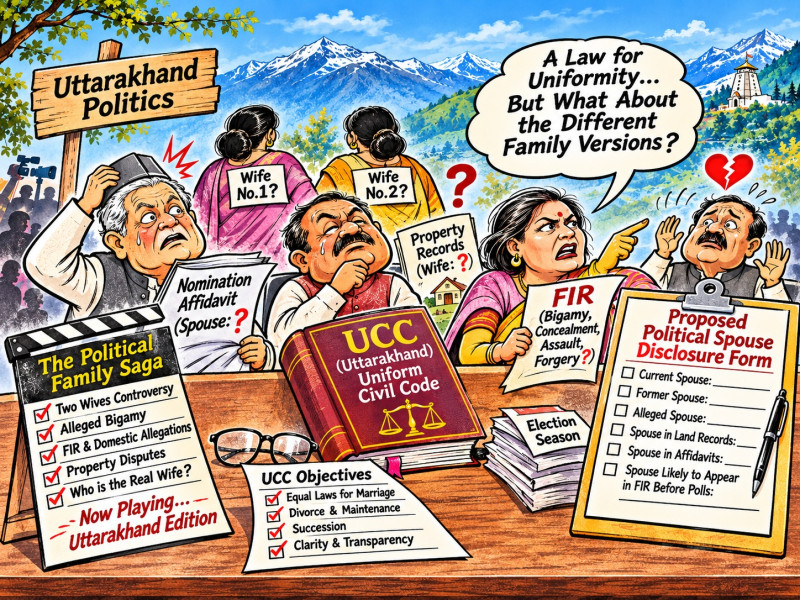
Uttarakhand has given India many things: hill stations, brave soldiers, and now—apparently—a Uniform Civil Code that looks suspiciously like it was drafted after a particularly awkward family WhatsApp group. The state’s political landscape has become a rich source of marital plot twists, with allegations, affidavits, FIRs, and “who is the real wife?” debates arriving faster than election manifestos.
“To be clear, these are allegations and disputes, not judicially settled verdicts; but as political theatre, the material is difficult to resist.”
The Original Screenplay
Former chief minister Harish Rawat’s “two wives” controversy is practically a classic of Uttarakhand political cinema. During the 2014 Dharchula by-election, his nomination papers named only Renuka Rawat as spouse, while the BJP alleged that Basanti Devi was his first wife and that the facts had been concealed. The Returning Officer found the nomination valid, and the Chief Electoral Officer suggested the BJP pursue legal remedies—an elegant bureaucratic way of saying, “This is your problem now.”
The BJP, naturally, saw an opportunity to campaign on morality. It invoked the Hindu Marriage Act, promised a court battle, and framed the issue as a matter of honesty in affidavits. One can almost hear the campaign jingle: One nation, one law—and, preferably, one clearly disclosed spouse.
The Sequel Nobody Ordered
Fast-forward to 2026, and the genre has evolved from affidavit-based melodrama to full-scale police procedural. Women and Child Development Minister Rekha Arya filed an FIR against her husband, Girdhari Lal Sahu, alleging that he concealed a prior marriage, committed bigamy, assaulted her, used casteist abuse, forged documents, and conspired against her and her children. These are serious allegations under investigation; they must be tested by evidence and due process, not settled by television debates.
Still, the irony writes itself. A minister responsible for women and child development finds herself alleging domestic cruelty and bigamy against her own husband after 22 years of marriage. Her complaint reportedly says she married in 2004 believing he was unmarried, and later learned he already had a wife and children.
“If Uttarakhand’s UCC was designed to promote clarity in marriage, the state’s political families appear determined to provide case studies with more twists than a hill road.”
Property, Papers, and “Real Wives”
Then comes former minister Harak Singh Rawat, whose marital status entered public discussion through a property dispute involving a woman named in land records as his wife. His long-standing wife, Dipti Rawat, publicly asserted that she is his only “real” wife and said the episode had caused the family severe distress. Again, this is a dispute involving claims and counterclaims—not a court-certified matrimonial biography.
But the symbolism is irresistible. In Uttarakhand politics, marriage is no longer merely a personal bond; it can surface in nomination papers, land registrations, FIRs, and election-season press conferences. The family album has apparently become a public record, with every page potentially useful to an opponent armed with a microphone.
The UCC Predicament
The state government presents the Uniform Civil Code as a modernising reform: equal rules for marriage, divorce, succession, and maintenance across communities. Fine. But after years of leaders being accused—fairly or otherwise—of opaque marriages, undisclosed spouses, and property-linked domestic complications, one suspects the drafters may have had a little personal motivation.
“Perhaps the UCC is not merely a legal code. Perhaps it is an administrative intervention into the state’s most persistent political genre: the marital-status mystery. If every leader had to declare their marital history with the precision of an income-tax return, Uttarakhand’s election commission might finally need fewer complaint letters and more filing cabinets.”
Elections, Morality, and Selective Outrage
With assembly polls approaching, these controversies will not remain confined to drawing rooms. The opposition will use them as proof of moral decay; the ruling party will call them private matters when convenient and public-interest issues when politically useful. Meanwhile, voters may reasonably ask why the same leaders who sermonise about family values seem to generate family-value headlines with such impressive regularity.
“The deeper problem is not whether a politician has one spouse, two alleged spouses, or a complicated property registry. It is the gap between public moral rhetoric and private accountability. When leaders make marriage, women’s safety, and family honour central political themes, their own conduct inevitably becomes fair ground for scrutiny—though scrutiny must remain factual, lawful, and free of presumption.”
A Modest Proposal- “Political Spouse Disclosure Form”
If Uttarakhand truly wants a UCC with teeth, it should begin with a simple addition: a “Political Spouse Disclosure Form.” Columns could include current spouse, former spouse, alleged spouse, spouse named in land records, spouse named in affidavits, and spouse likely to appear in an FIR before polling day.
Until then, the state’s politicians will continue to preach uniformity while practising exceptional plot development. Uttarakhand may have one civil code, but its political families clearly operate under a different law: the Law of Unintended Headlines.