
 Dr. Shikha Mishra
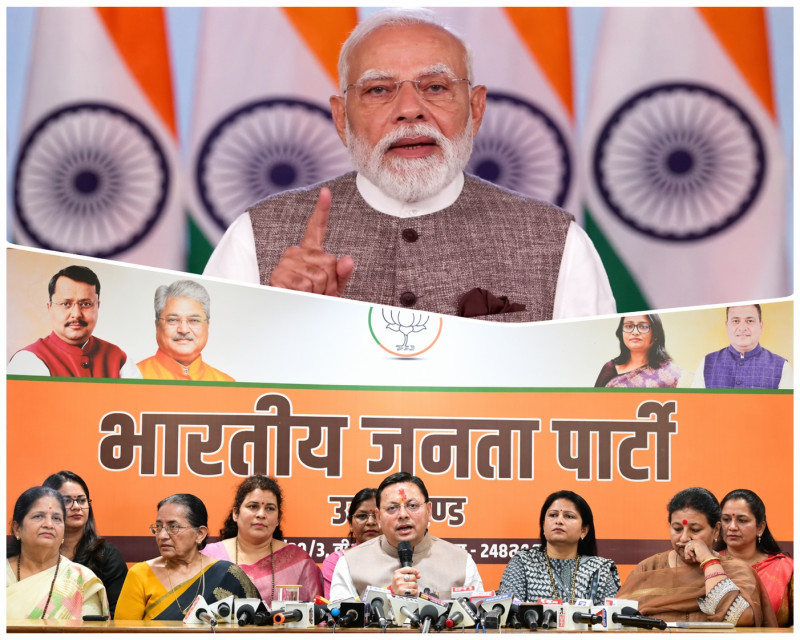
Dehradun: Uttarakhand Chief Minister Pushkar Singh Dhami launched a blistering attack on the Opposition, transforming the debate around the Women’s Reservation Bill into a fierce political and moral confrontation that has gripped national attention. Dhami has delivered a sharp and emotionally charged response following the recent developments around the Women’s Reservation Bill, turning the spotlight on what he described as a “defining moment” for India’s commitment to women’s empowerment.
In a carefully choreographed show of support for women’s leadership, Uttarakhand Chief Minister Pushkar Singh Dhami held his press conference surrounded by women BJP leaders, a move widely seen as a deliberate attempt to underscore the prominence of matrishakti in the state. The visual positioning highlighted the party’s messaging on women’s empowerment, projecting Uttarakhand as a region where women play a central role in politics and public life.
Uttarakhand Chief Minister Pushkar Singh Dhami on Friday launched a sharp attack on the Opposition, asserting that the BJP remains firmly committed to women’s empowerment and will continue to push for the Women’s Reservation Bill. Highlighting Uttarakhand’s relatively higher representation of women legislators, Dhami described the state as a land of “matrishakti,” crediting women for their key role in the statehood movement and their growing leadership across sectors. He accused the Congress of “consistently obstructing nation-building reforms,” citing its opposition to measures such as triple talaq legislation, the Citizenship Amendment Act (CAA), and the abrogation of Article 370. Dhami further alleged that the Opposition was misleading the public on the issue of delimitation and attempting to create confusion around constitutional processes. Reiterating the Centre’s focus on women-centric initiatives under Prime Minister Narendra Modi—including schemes like Beti Bachao, Beti Padhao and Lakhpati Didi—he said both the Centre and the state government remain committed to ensuring safety, development, and political empowerment of women, while vowing to continue efforts toward securing greater representation for them in legislatures.
In a statement charged with urgency and conviction, Dhami asserted that Prime Minister Narendra Modi’s address to the nation on the Nari Shakti Vandan Adhiniyam was not merely a policy articulation but a powerful declaration of intent—one that reaffirmed the Centre’s commitment to restoring dignity, representation, and rightful space to women in India’s political landscape. He emphasized that the Prime Minister’s speech laid bare the “true face” of opposition parties, accusing them of obstructing a historic step toward gender justice.
Calling the failure to pass the constitutional amendment “deeply regrettable” and “a crushing setback,” Dhami said the moment marked a missed opportunity in India’s democratic journey. “This is not just a legislative lapse—it is a blow to the aspirations of millions of women who have waited decades for equitable political representation,” he said, underscoring the emotional weight of the issue.
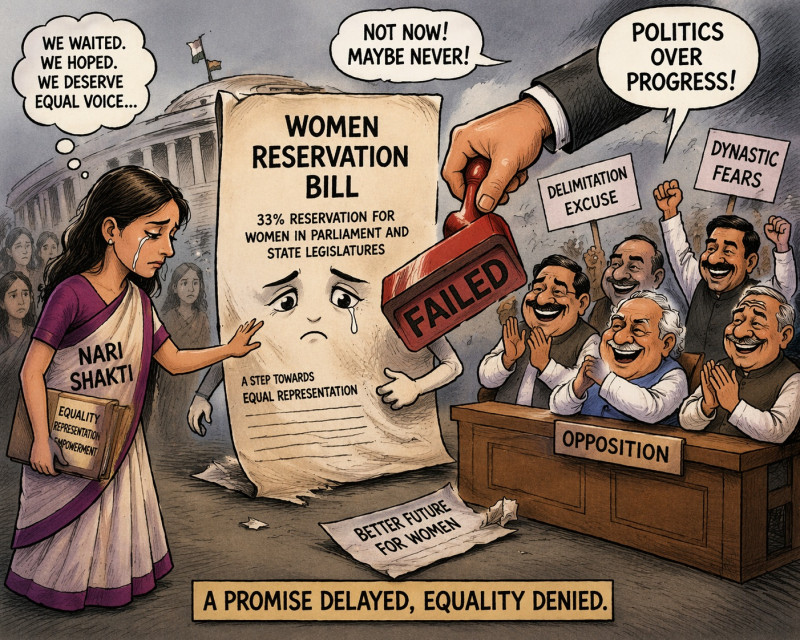
However, it was the Opposition’s reaction that drew Dhami’s sharpest criticism. He condemned reports of celebratory reactions following the bill’s setback, describing them as “deeply insensitive” and “morally indefensible.” According to him, such conduct reflects a troubling disconnect from the ground realities faced by women across the country. “Celebrating the fall of a bill that seeks to empower women is not politics—it is a stark display of disregard for the nation’s nari shakti,” he remarked.
Dhami went further, warning that such actions strike at the very foundation of democratic values. “Democracy thrives on inclusion, respect, and progress. When those entrusted with public responsibility mock the cause of women’s empowerment, they erode the spirit of democracy itself,” he said. He framed the episode not just as a political disagreement, but as a defining test of the country’s collective conscience.
Despite the intensity of his criticism, the Chief Minister struck a note of resilience and determination. He expressed confidence that women across India would respond with strength and clarity through democratic means. “The voice of women cannot be silenced. This moment will only strengthen their resolve to claim what is rightfully theirs,” he said, hinting at a larger political and social reckoning ahead.
Reaffirming his government’s commitment, Dhami emphasized that Uttarakhand will continue to push forward policies aimed at empowering women at every level—from education and employment to leadership and governance. “Our efforts will not slow down. We remain steadfast in our mission to ensure that women are not just participants, but leaders in shaping the future of our state and nation,” he added.
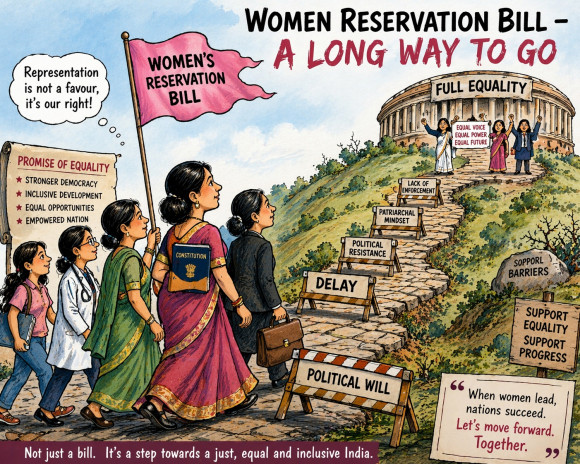
As the political temperature rises, the controversy surrounding the Women’s Reservation Bill has clearly transcended parliamentary boundaries. It now stands as a flashpoint—where ideology, accountability, and the promise of gender equality collide in full public view.