
 Dr. Shikha Mishra
Women’s Reservation and Delimitation: Reform Deferred or Rethought?
Dr Shikhha Mishra
Editor, Lead Reporting
Ph.D. & M.Phil. in Journalism and Mass Communication
Editorial experience with—The Indian Express, The Pioneer, and Hindustan Times
A seasoned journalist, senior media educator and researcher with 19+ years of experience
Author and Patent Holder
The View: A Historic Opportunity Lost
Supporters regard the bill as a significant step toward advancing gender equality, in line with the provisions of Article 15(3), which allow the state to make special measures for women. They argue that it would promote more inclusive and representative policymaking while also supporting India’s commitment to achieving gender equality as outlined in Sustainable Development Goal 5 (SDG-5).
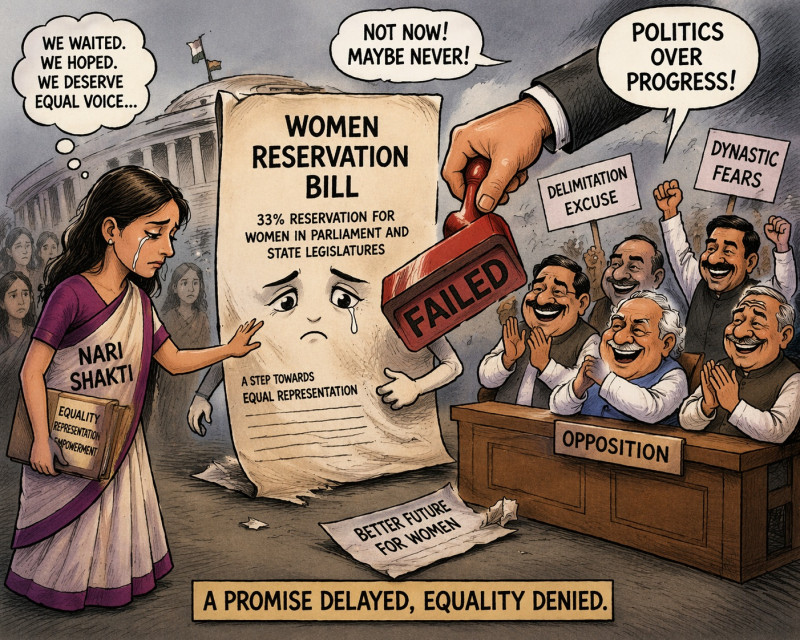
The failure of the Women’s Reservation Bill—tied to the proposed delimitation exercise—marks, for many, a profound setback in India’s democratic evolution. At its core, the legislation promised to reserve 33% of seats in Parliament and state assemblies for women, a long-pending reform aimed at correcting a glaring imbalance in political representation.
Proponents, including Narendra Modi, framed the bill as a decisive leap toward gender justice. With women constituting nearly half the population yet occupying a fraction of legislative seats, the measure was seen as both necessary and overdue. Its passage could have triggered a structural shift—bringing more women into decision-making spaces and reshaping policy priorities toward health, education, and social equity.
The linkage with delimitation—the redrawing of constituencies based on population—was presented as an attempt to ensure fairness and uniformity in implementation. Advocates argued that without such a mechanism, reservation could become uneven or politically skewed.
From this perspective, the bill’s defeat is not merely legislative gridlock; it is a symbolic fracture in the promise of inclusive governance. It delays the entry of countless capable women into politics and risks reinforcing the status quo, where representation remains disproportionately male-dominated.
The Counterview: The Unseen Catch
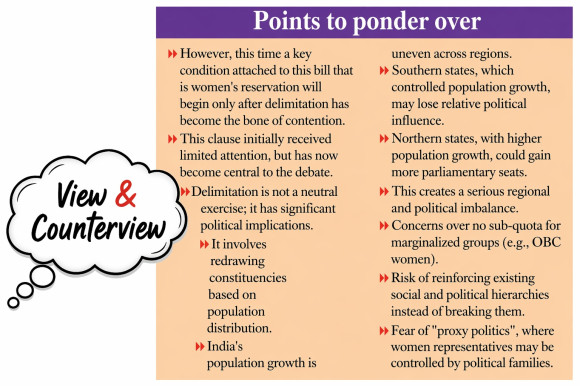
The 2023 law on women’s reservation was passed, not rejected, but with a crucial condition that has now come under scrutiny: its implementation is tied to a future delimitation exercise. While this clause initially drew little attention, it has since become central to the political debate. Delimitation, which involves redrawing constituencies based on population, is far from a neutral process. With India’s uneven population growth, southern states that successfully controlled their population may see a decline in political influence, while northern states with higher growth could gain more seats in Parliament. This has raised concerns over a potential regional imbalance, intensifying political tensions that were long anticipated but rarely addressed openly.
Critics, however, have consistently questioned both the design and the intent of the bill. Their central argument is that tying women’s reservation to delimitation effectively postpones empowerment. Since delimitation is a complex and politically sensitive process with no immediate timeline, the reservation promise, they contend, becomes aspirational rather than actionable.
Opposition voices have also raised concerns about the absence of sub-quotas within the reservation framework. Without provisions for marginalized groups—such as OBC women—the bill risks benefiting only a narrow segment, potentially reinforcing existing hierarchies rather than dismantling them.
Moreover, skepticism persists about the practical impact of reservation itself. Detractors warn of “proxy politics,” where elected women representatives may operate under the influence of entrenched political families, thereby limiting genuine empowerment.
From this standpoint, the bill’s failure may not be an outright loss but an opportunity to revisit its architecture. A more immediate, inclusive, and clearly defined framework—decoupled from delimitation—could yield stronger and more equitable outcomes.
Reservation vs Real Power: The “Pradhanpati” Paradox in Women’s Political Representation
This heading in itself suffice to reflect the intention of what lies ahead after the fall of women reservation bill? We cannot rule out the existing truth of reservation given to women at Panchayat level that how their husbands hold the real power and “Mahila Pradhan” is just a proxy hardly plays any role in power politics or decision making.
The persistence of the “Pradhanpati” phenomenon—where husbands of elected women Gram Pradhans wield the actual authority—lays bare a troubling contradiction in India’s democratic framework. While reservation policies in Panchayati Raj institutions have undeniably increased the numerical presence of women in grassroots governance, they have not always translated into genuine decision-making power. In many cases, elected women remain nominal heads, while their male counterparts operate from behind the scenes, taking key decisions, attending meetings, and controlling resources. This reduces the idea of reservation to a procedural formality rather than a transformative shift in power.
This gap between representation and authority raises a critical question: what is the real value of reservation if power continues to reside within entrenched patriarchal structures? The intent of reservation is not merely to fill seats with women, but to empower them as independent political actors capable of shaping policy and governance. However, without institutional safeguards, leadership training, and social change, reservation risks becoming a tool that reinforces, rather than challenges, existing hierarchies.
This concern becomes even more significant when viewed in the context of the proposed Women’s Reservation Bill for Parliament and state assemblies. If similar patterns of proxy politics emerge at higher levels, the reform may fall short of its promise. The debate, therefore, must move beyond numbers to focus on agency, autonomy, and accountability. True empowerment lies not in reserved seats alone, but in ensuring that women occupying those seats exercise real authority—free from control, influence, or substitution by male proxies.
The rejection of the bill has undeniably intensified the political and moral debate. Supporters see it as a missed moment of courage; critics view it as a pause that allows for necessary recalibration.
What remains undeniable is that the question is no longer whether women deserve greater political representation—it is how and when it will be delivered. The path forward must reconcile urgency with inclusivity, symbolism with substance.
In the end, the true measure of this debate will lie not in rhetoric, but in whether India can translate its commitment to nari shakti into concrete, timely, and equitable political reform.