
 LR Bureau
Dr Ravindra Kumar
Professor Dr. Ravindra Kumar ( Padma Shri Awardee)
Former Vice Chancellor, CCS University, Meerut;
Ombudsman/ Professor Chair Swami Vivekananda Research Centre
Swami Vivekanand Subharti University, Meerut;
Advisor, Business Economics, Kolkata, India
ravindrwpmt@gmail.com; ravindrakumar5@hotmail.com
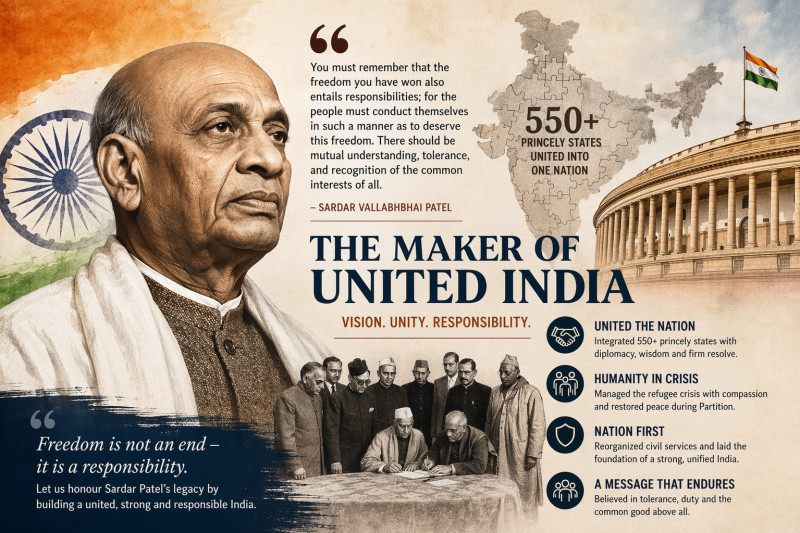
“You must remember that the freedom you have won also entails responsibilities; for the people must conduct themselves in such a manner as to deserve this freedom.” These words of Sardar Vallabhbhai Patel are not merely a reflection of the past—they are a warning, a guide, and a timeless principle for the present and future of India. At a moment when the nation had just emerged from colonial rule, Patel understood that independence was not the culmination of struggle, but the beginning of a far more demanding journey: the building of a united, stable, and responsible nation.
Patel’s legacy is often condensed into a single achievement—his decisive role in integrating more than 550 princely states into the Union of India after August 15, 1947. Yet, this description hardly captures the magnitude of what he accomplished. India, at the time of independence, was not a naturally cohesive political entity. It was a fragmented landscape of kingdoms, provinces, and territories, each with its own interests, ambitions, and uncertainties. The possibility of disintegration was real and imminent. In this fragile environment, Patel’s firm yet pragmatic leadership ensured that the dream of a united India did not remain an ideal, but became a political reality.
This integration was not achieved through force alone, nor through rhetoric, but through a combination of diplomacy, persuasion, strategic foresight, and when necessary, decisive action. It was a delicate balancing act between respecting regional identities and asserting national unity. Patel recognized that unity was not merely territorial—it had to be political, administrative, and emotional. For this reason, he is rightly remembered as the “Maker of United India.”
However, to reduce Patel’s contribution to territorial consolidation alone would be to overlook the deeper philosophy that guided his actions. He firmly believed that political freedom, if not accompanied by a sense of duty among citizens, could easily descend into chaos. His repeated emphasis on responsibility was rooted in the understanding that democracy demands discipline, tolerance, and collective effort. Freedom, in his view, was not a license for disorder, but a call for higher civic conduct.
The relevance of this philosophy became starkly evident during the Partition of India—a period marked by unprecedented human suffering, displacement, and communal violence. Millions crossed borders in search of safety, while the newly independent state struggled to cope with the magnitude of the crisis. Patel was at the forefront of managing this humanitarian disaster. He oversaw the rehabilitation of refugees, the restoration of order, and the rebuilding of shattered lives. Yet, beyond administrative measures, he recognized that the crisis required moral intervention.
His address in Amritsar on September 30, 1947, stands as a defining moment in this regard. At a time when communal tensions threatened to spiral out of control, Patel spoke not as a politician seeking support, but as a statesman appealing to the conscience of the people. He warned against the dangers of vengeance and retaliation, reminding citizens that the lives of millions were at stake. His insistence on maintaining peace and ensuring safe passage for refugees was not merely a policy directive—it was an ethical stance. Remarkably, his words had an immediate calming effect, demonstrating the power of leadership grounded in moral clarity.
This episode underscores a critical dimension of Patel’s leadership: his ability to combine firmness with compassion. He was unyielding when it came to national unity and security, yet deeply humane in his approach to people. This balance distinguished him from many of his contemporaries and remains a rare quality in public life.
In the years immediately following independence, India faced a series of formidable challenges. The administrative machinery inherited from colonial rule had to be restructured. Law and order needed to be maintained in a volatile environment. The threat of internal divisions and external pressures loomed large. Patel approached these challenges with remarkable clarity and determination. His role in reorganizing the civil services, particularly in establishing the All India Services, laid the foundation for a stable and efficient administrative system. He understood that a strong nation requires not just political unity, but also institutional strength.
Yet, perhaps Patel’s most enduring contribution lies in the values he sought to instill in the nation. He consistently emphasized unity, not as a political slogan, but as a lived principle. For him, unity required tolerance—the willingness to accommodate differences, to respect diversity, and to prioritize the common good over individual or sectional interests. In a country as diverse as India, this principle was not optional; it was essential for survival.
Today, as India navigates the complexities of the 21st century, Patel’s message acquires renewed significance. The challenges may have changed in form, but the underlying tensions—between unity and division, rights and responsibilities, individual aspirations and collective welfare—remain. In contemporary discourse, there is often a strong emphasis on rights and freedoms, which are indeed fundamental to democracy. However, Patel’s vision reminds us that rights cannot be sustained in the absence of responsibility.
The erosion of civic responsibility can manifest in many ways—social divisions, intolerance, disregard for law, and weakening of institutions. Patel’s life and work serve as a counterpoint to these tendencies. He demonstrated that true strength lies not in assertion alone, but in restraint; not in division, but in cohesion; not in rhetoric, but in action.
To remember Sardar Vallabhbhai Patel, therefore, is not merely to pay tribute to a historical figure. It is to engage with a set of ideas that are foundational to the Indian republic. His legacy challenges us to ask difficult questions: Are we, as citizens, living up to the responsibilities that accompany our freedoms? Are we contributing to unity, or allowing divisions to deepen? Are we upholding the values that underpin our democracy?
In an era marked by rapid change and competing narratives, Patel’s voice offers clarity. His belief in unity, discipline, and collective responsibility provides a framework for navigating contemporary challenges. It reminds us that nation-building is not a one-time event, but an ongoing process that requires constant vigilance and participation.
Ultimately, Patel’s message is both simple and profound: freedom is not an end in itself—it is a responsibility. The strength of a nation lies not only in its institutions or its leaders, but in the character of its people. If India is to continue its journey as a strong, united, and democratic nation, it must internalize the values that Patel championed.
In reflecting on his legacy, one is reminded that the true measure of independence lies not in its attainment, but in its preservation. And that preservation depends, as Patel so clearly articulated, on the willingness of citizens to act with responsibility, tolerance, and a sense of shared destiny.