
 L R Bureau

Dr Rakesh Sharma
1984-batch IFS officer with extensive experience in education administration and governance.
Held key positions in NVS, CTSA, AICTE, IIT Delhi, and the Himachal Pradesh Government.
Former Vice-Chancellor of Graphic Era University.
Currently serving as Pro-Chancellor of Graphic Era University.
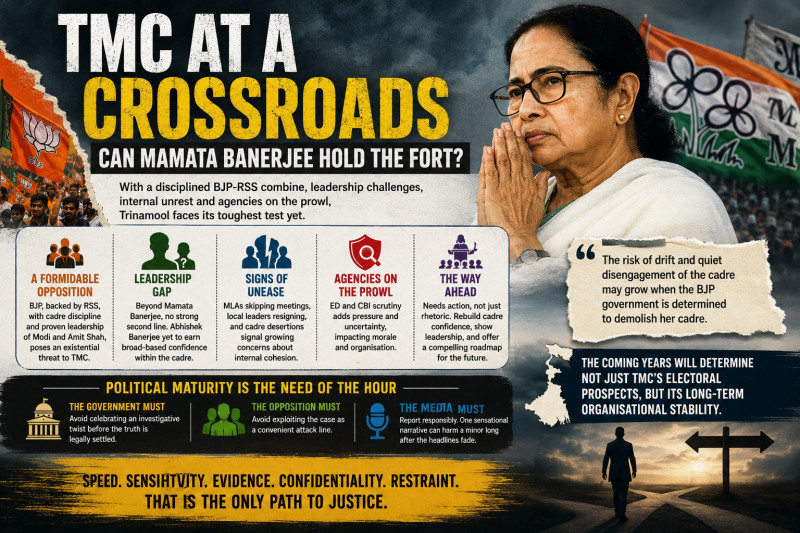
The political atmosphere in West Bengal is entering a period of unmistakable turbulence, and at the centre of this uncertainty stands the All India Trinamool Congress led by Mamata Banerjee. For more than a decade, Mamata Banerjee dominated Bengal’s political landscape through an extraordinary mix of populist politics, aggressive street-level mobilisation, welfare-driven governance, and a deeply personalised leadership style. Today, however, the Trinamool Congress appears to be confronting one of the most serious challenges of its political existence.
The rise of the Bharatiya Janata Party in Bengal is no longer a temporary electoral surge; it has evolved into an ideologically driven, cadre-based expansion supported by the organisational discipline of the Rashtriya Swayamsevak Sangh. Unlike earlier opposition formations that failed to sustain momentum against the Trinamool’s formidable grassroots machinery, the BJP combines central political power, organisational patience, and long-term electoral strategy. More importantly, it operates under the nationally dominant leadership of Narendra Modi and Amit Shah, leaders who have repeatedly demonstrated their ability to weaken entrenched regional parties across India.
For the TMC, the concern is not merely electoral competition; it is the growing perception of organisational vulnerability. Mamata Banerjee remains the undisputed face of the party, but therein lies the structural weakness. The Trinamool Congress has long revolved around a centralised command model where political legitimacy flows almost entirely from Mamata herself. While this model ensured discipline and loyalty during periods of political dominance, it has also prevented the emergence of an independent and credible second line of leadership.
This absence of succession planning is becoming increasingly visible. Abhishek Banerjee may hold significant organisational authority, but he has yet to command universal trust across the party’s older cadre base. Within the party, concerns persist regarding whether his leadership possesses the mass appeal, emotional connect, and combative instinct that Mamata Banerjee cultivated over decades of political struggle. Dynastic transitions in Indian regional politics often succeed only when accompanied by organic cadre acceptance. In the TMC’s case, that transition appears incomplete and uncertain.
The recent signs of unease within the organisation have therefore attracted serious political attention. Reports of local-level resignations, visible cadre desertions, and even the absence of some MLAs from key post-election meetings indicate more than routine dissatisfaction. They suggest an emerging crisis of confidence. Political workers are often the first to sense shifts in power equations, and in highly competitive states like Bengal, even a perception of weakening leadership can accelerate organisational erosion.
The BJP understands this vulnerability well. Its strategy in Bengal appears designed not only to challenge the TMC electorally but also to psychologically demoralise its cadre structure. Investigative scrutiny by agencies such as the Enforcement Directorate and Central Bureau of Investigation has added another layer of pressure on the ruling party. Whether these investigations are viewed as legitimate anti-corruption efforts or politically timed interventions, their political effect is undeniable: they create uncertainty, defensive politics, and internal anxiety within the Trinamool ecosystem.
For Mamata Banerjee, this moment demands more than rhetorical resistance. Her political career was built on relentless street combat, emotional mobilisation, and the image of an indomitable fighter against powerful adversaries. But political survival now requires institutional consolidation rather than only charismatic defiance. She must reassure the cadre that the party still possesses strategic direction, ideological clarity, and organisational resilience.
The lessons from the decline of the Indian National Congress and the Left Front in Bengal are impossible to ignore. Both parties once appeared electorally invincible until complacency, cadre fatigue, and organisational drift hollowed them out from within. Mamata Banerjee, as a seasoned politician, understands that political decline often begins silently — through quiet disengagement at the grassroots.
The coming years may therefore prove decisive not only for the electoral future of the TMC but for its very identity as Bengal’s dominant political force. If the party fails to reinvent its internal structure, nurture broader leadership, and revive confidence among its workers, the threat before it may evolve from political challenge into existential crisis.