
 Dr. Shikha Mishra
The Battle Against Deadly Superbugs May Begin Not In Hospitals, But In The Farming Fields To Fight Against Antibiotic Resistance

Dr Ankita Rani
- Lifetime Member of UNESCO Association
- Postdoctoral Researcher based in Taichung, Taiwan
- PhD in Biotechnology
- Currently affiliated with Feng Chia University
- Leads Eco-Technologies Partnership, linking institutions across:Taiwan, India, Indonesia, and Italy
- Collaborations with- Ministry of Environment (Taiwan), PHD Chamber of Commerce and Industry and Italian National Research Council
- Recipient of Young Innovator Research Award
- Expertise in scientific research with policy and industry impact
When farmers in Uttarakhand prepare their fields for the next crop, few would imagine that the soil beneath their feet could play a role in one of the world's biggest public health crises. Yet scientists are increasingly warning that the next generation of antibiotic-resistant "superbugs" may not emerge from hospitals or clinics—it may already be developing silently in agricultural soils.
For most people, antibiotic resistance is associated with hospitals: a patient who no longer responds to medicines, a doctor running out of treatment options, or an infection that becomes impossible to cure. While this picture is familiar, it tells only part of the story.
The real battle against antibiotic resistance begins much earlier—and much closer to home.
The World Health Organization (WHO) has identified Antimicrobial Resistance (AMR) as one of the greatest health threats of the 21st century. Every year, resistant infections claim hundreds of thousands of lives worldwide. If urgent action is not taken, experts warn that the number could rise dramatically in the coming decades.
From Farms to Hospitals: The Agricultural Roots of Antibiotic Resistance
What many people do not realize is that antibiotic resistance is not just a medical issue; it is also an environmental and agricultural issue.
Soil is one of the most biologically active ecosystems on Earth. A single gram of healthy soil contains billions of microorganisms. For millions of years, these microbes have competed with one another, producing natural antibiotics and developing ways to resist them. In fact, many modern antibiotics were originally discovered in soil bacteria.
The problem arises when human activities accelerate this natural process.
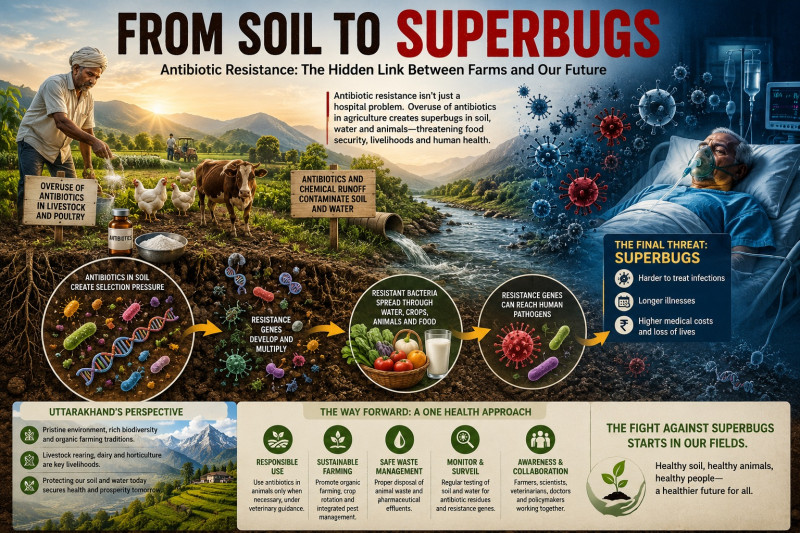
When antibiotics are excessively used in livestock, poultry, fisheries, or enter the environment through pharmaceutical waste, they create what scientists call "selection pressure." Simply put, weaker bacteria die while resistant ones survive and multiply. Over time, the soil becomes a reservoir of resistance genes that can spread to other bacteria, including those capable of causing disease in humans.
These resistant microbes do not stay confined to the fields. They can travel through water, crops, dust, animals, and even food chains before eventually reaching human populations.
For a country like India, where agriculture supports millions of livelihoods, this challenge is particularly significant.
Why Uttarakhand Should Be Concerned (BOX HIGHLIGHTED)
Uttarakhand is often celebrated for its pristine environment, organic farming initiatives, and rich biodiversity. However, the state is not immune to emerging environmental health risks.
Agriculture remains the backbone of rural livelihoods across the hill districts. Livestock rearing, dairy farming, poultry, and horticulture are equally important. As agricultural practices modernize, the use of veterinary medicines, fertilizers, and chemical inputs is also increasing in many regions.
The state's rivers, streams, and mountain ecosystems are especially sensitive. Any contamination of soil or water with antibiotic residues can have far-reaching consequences—not only for farmers but also for communities dependent on these natural resources.
Unlike urban hospitals where infections can be monitored, resistant microbes in soil often remain invisible until they manifest as larger public health problems.
This is why experts believe that states like Uttarakhand have a unique opportunity to act early and become models of sustainable agriculture and environmental stewardship.
Farmers as Frontline Defenders
The good news is that farmers are not part of the problem—they can be a major part of the solution.
Simple and sustainable agricultural practices can significantly reduce the risk of antibiotic resistance spreading through the environment. These include:
- Judicious use of veterinary antibiotics under professional guidance.
- Crop rotation and diversified farming systems.
- Integrated pest management to reduce dependence on chemical inputs.
- Proper disposal of animal waste and farm effluents.
- Encouraging organic and natural farming methods wherever feasible.
Many farmers in Uttarakhand are already moving towards low-chemical and organic cultivation. Strengthening these efforts can help preserve soil health while simultaneously reducing the emergence of resistant microbes.
A One Health Approach (Box Highlight)
Scientists now advocate a concept known as "One Health," which recognizes that human health, animal health, and environmental health are deeply interconnected.
A disease emerging in animals can affect humans. Contaminated water can impact crops. Resistant bacteria developing in soil can eventually become a medical crisis.
Therefore, combating antibiotic resistance requires cooperation among doctors, veterinarians, agricultural scientists, environmental experts, policymakers, and farmers.
Monitoring soil and water quality, regulating pharmaceutical waste, promoting responsible antibiotic use, and strengthening awareness at the community level are all essential components of this strategy.
Looking Beyond the Hospital Walls
Hospitals will continue to play a critical role in combating antibiotic resistance through responsible prescribing and infection control. However, focusing solely on healthcare settings is no longer enough.
The roots of the problem often lie upstream—in our fields, farms, waterways, and ecosystems.
For Uttarakhand, where agriculture and nature remain deeply intertwined, protecting soil health is not merely an environmental concern; it is an investment in public health, food security, and the well-being of future generations.
The lesson is simple but profound: the fight against superbugs does not begin at the bedside. It begins in the soil. And in that fight, every farmer has a vital role to play.