

 Dr. Shikha Mishra
NHAI's Rishikesh Highway: Green Optics or Gray Realities?
Dr Shikhha Mishra
Editor, Lead Reporting (English Weekly)
Ph.D. & M.Phil. in Journalism and Mass Communication
Editorial experience with—The Indian Express, The Pioneer & Hindustan Times
A seasoned journalist, senior media educator, Media & Communication Researcher
Author and Patent Holder
Development and conservation are often presented as opposing forces. The proposed Bhaniyawala–Jolly Grant–Rishikesh four/six-lane highway in Uttarakhand has reignited this debate, raising a fundamental question: Can large-scale infrastructure truly coexist with ecological preservation, or are environmental safeguards merely softening the image of irreversible ecological loss?
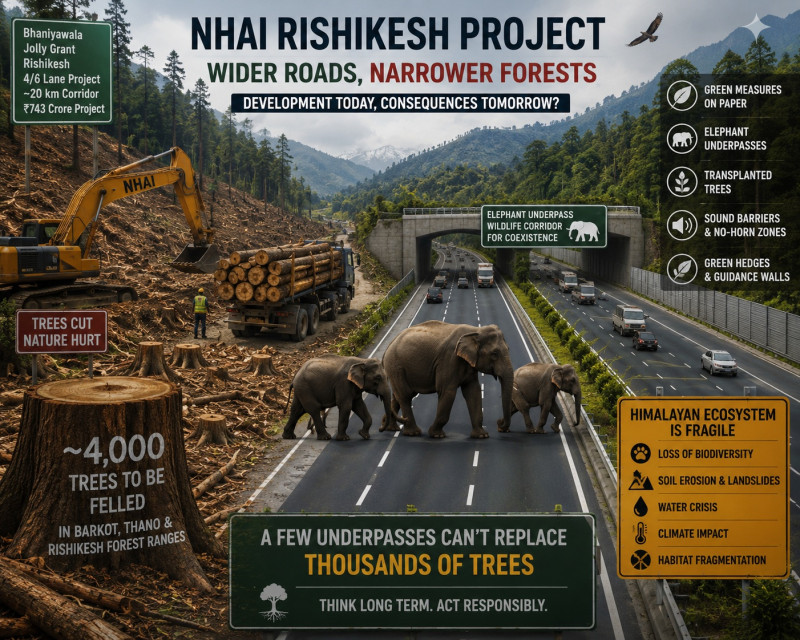
The National Highways Authority of India (NHAI) has projected the Bhaniyawala–Jolly Grant–Rishikesh highway as a benchmark in environmentally conscious infrastructure. The project incorporates elephant underpasses, wildlife-friendly elevated corridors, sound barriers, reduced Right of Way through forest stretches, transplanted trees, and guidance from conservation experts. Officials argue that these interventions demonstrate a new generation of infrastructure planning where development and environmental protection can move together.
There is considerable merit in this argument. Uttarakhand's road infrastructure has struggled to keep pace with rapidly increasing traffic generated by tourism, the Char Dham Yatra, defence logistics, and local economic activity. The Rishikesh corridor serves as the gateway to the Garhwal Himalayas and witnesses heavy congestion throughout the year. Improved connectivity could reduce travel time, improve emergency response, enhance road safety, lower fuel consumption during traffic jams, and strengthen economic opportunities for local communities dependent on tourism and commerce.
The inclusion of dedicated elephant underpasses marks a shift towards wildlife-sensitive infrastructure, with scientific inputs, no-horn zones, and green barriers designed to minimise ecological disturbance and improve habitat connectivity. Supporters argue that Uttarakhand's growing population, expanding tourism, and strategic importance require modern roads to enhance healthcare, disaster response, trade, education, and pilgrimage management, asserting that sustainable development must balance environmental conservation with essential infrastructure needs.
Yet the counterargument is equally compelling—and perhaps more urgent.
Behind the narrative of green engineering lies the reality that approximately 4,000 mature trees are proposed to be felled across the ecologically sensitive Barkot, Thano, and Rishikesh forest ranges. These are not ordinary plantations that can be recreated overnight. Many are mature sal and mixed-species trees that have evolved over decades, forming a complex ecological network that supports biodiversity, regulates local climate, stores carbon, conserves groundwater, and stabilises fragile Himalayan soils.
The environmental consequences of large-scale tree felling extend far beyond the visible disappearance of forests.
Trees act as natural air conditioners by absorbing heat and releasing moisture through transpiration. Their removal increases local temperatures, creating urban heat islands and altering microclimatic conditions. Reduced tree cover also diminishes atmospheric humidity and can disrupt local rainfall patterns over time. In a Himalayan state already experiencing rising temperatures due to climate change, such ecological disturbances may accelerate warming trends.
Perhaps even more concerning is the impact on soil stability.
The extensive root systems of mature trees bind the soil together, preventing erosion and reducing the risk of landslides. Once these trees are removed, exposed slopes become highly vulnerable to heavy monsoon rainfall. The Himalayan terrain is geologically young and naturally unstable. Road cutting combined with deforestation significantly increases the likelihood of slope failures, debris flows, and flash floods.
History offers several cautionary lessons. Large-scale road widening projects in Uttarakhand have frequently been followed by increased incidences of landslides during monsoon seasons. While rainfall remains the immediate trigger, weakened slopes often reflect cumulative human intervention over many years.
Groundwater recharge also suffers after tree removal
Forest floors function like natural sponges, allowing rainwater to slowly infiltrate the ground and replenish underground aquifers. Tree roots create channels that facilitate water percolation. Once forests disappear, rainfall rapidly flows over hardened surfaces, leading to surface runoff instead of groundwater recharge. Ironically, regions receiving abundant rainfall may subsequently experience declining groundwater levels and seasonal water scarcity.
The consequences extend to rivers as well
Without adequate forest cover, soil erosion accelerates, washing sediments into rivers, reducing their carrying capacity, degrading aquatic ecosystems, and heightening downstream flood risks. Construction debris and pollutants further contaminate fragile water systems. While elephant underpasses are a positive step, they cannot offset widespread habitat fragmentation. Continuous forests sustain breeding grounds, pollinator networks, and interconnected habitats for thousands of species, whereas highways introduce noise, artificial light, vibrations, pollution, and constant human disturbance that fundamentally alter wildlife behaviour. Equally, tree transplantation is no substitute for mature forests. Large trees rarely survive relocation at projected rates, and even successful transplants take decades to restore lost ecological functions such as carbon sequestration, canopy cover, biodiversity support, and natural habitat connectivity.
Another concern is the phenomenon of induced traffic
High-capacity highways often provide only temporary congestion relief, as they attract more vehicles, tourism, urbanisation, commercial activity, and real estate development, increasing pressure on forests, water resources, waste management, and biodiversity. Critics advocate greater investment in public transport, electric buses, railways, multimodal hubs, and regulated tourism, arguing that sustainable mobility should manage travel demand rather than continually expanding roads through ecologically fragile regions.
This debate ultimately reflects a broader challenge confronting Himalayan development.
Infrastructure is vital for economic growth, disaster resilience, national security, tourism, and public welfare, but ecological limits cannot be overcome by engineering alone. Sustainable development requires balancing conservation with connectivity through evidence-based planning, cumulative environmental impact assessments, transparent public consultations, rigorous post-construction ecological monitoring, and greater investment in nature-based solutions alongside physical infrastructure.
The real question is not whether Uttarakhand needs better roads—it undoubtedly does. But the point is that whether those roads are being planned with sufficient respect for the ecological systems that sustain the state's economy, culture, and people. A highway may reduce travel time by a few minutes, but the loss of mature forests could leave consequences measured not in minutes or years, but in generations.
If the Bhaniyawala–Jolly Grant–Rishikesh project truly seeks to become a model of sustainable infrastructure, its success should not be judged merely by engineering innovation or construction speed. It must ultimately be measured by whether future generations inherit a safer, greener, and more resilient Uttarakhand—or one where development came at the irreversible cost of its forests, rivers, wildlife, and environmental security.