

 LR Bureau
Hormuz: A Global Power Game, More Than a Waterway

Dr Santosh Kumar
GUEST EDITOR
(Dr. Santosh Kumar is an International Relations expert and political analyst, Associate Professor at BBD University, Lucknow, TV panellist, and author of Emerging Dimensions of International Relations. He is widely published and known for his incisive academic and media contributions.)
The Strait of Hormuz has once again emerged as the focal point of geopolitical tensions in West Asia. The latest confrontation between the United States and Iran has shifted global attention to this narrow yet strategically indispensable waterway, through which a substantial share of the world's oil and natural gas supplies passes every day. Although the recent ceasefire between the two countries had raised hopes of stability, renewed exchanges of hostile rhetoric and military actions have exposed the fragility of peace in the region. The Strait of Hormuz has become much more than a maritime passage—it is now a symbol of power, influence, energy security, and strategic competition.
The latest dispute revolves around competing claims over the security and control of the strait. The United States has projected itself as the guarantor of safe navigation and has indicated that commercial vessels should contribute towards the cost of maritime security. Iran, however, has categorically rejected such assertions, maintaining that no external power has the authority to regulate or control navigation in waters adjoining its territory. The disagreement has once again highlighted how the Strait of Hormuz lies at the centre of the strategic rivalry between Washington and Tehran.
The ceasefire understanding between the two countries was largely built on the assurance of safe and uninterrupted passage through the Strait of Hormuz. However, the recent escalation suggests that this understanding remains extremely fragile. Military strikes, retaliatory attacks, and diplomatic confrontations continue to threaten regional stability. The United States has targeted strategic installations inside Iran, while Iran has retaliated by attacking locations associated with American military interests in Gulf Cooperation Council (GCC) countries. Every escalation increases the possibility of disruption in one of the world's most important maritime trade routes.
The significance of the Strait of Hormuz extends far beyond the immediate conflict. Geography has always shaped international politics, and control over strategic waterways has historically translated into political and economic influence. Oceans, mountains, rivers, and maritime chokepoints continue to determine the balance of power among nations. The geographical isolation of the United States protected it from the devastation experienced by Europe during the First and Second World Wars, enabling it to emerge as a global superpower. Likewise, the Himalayas served as India's natural defensive barrier for centuries. Strategic locations such as Greenland, the South China Sea, the Suez Canal, and the Strait of Hormuz continue to influence global diplomacy and military planning.
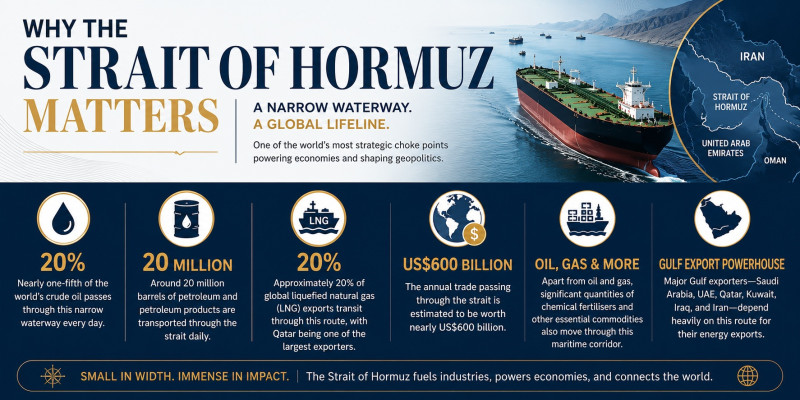
The Strait of Hormuz exemplifies this geopolitical reality. Situated between Iran to the north and Oman and the United Arab Emirates to the south, it forms the only maritime gateway connecting the Persian Gulf with the Gulf of Oman and the Arabian Sea. At its narrowest point, the strait is approximately 33 kilometres wide, making it one of the world's most vulnerable maritime chokepoints. Historically, it has served as an important commercial route since the Bronze Age, facilitating trade between the Middle East, India, China, and beyond. Even today, its strategic value remains unmatched.
Iran considers the Strait of Hormuz one of its strongest geopolitical assets. Throughout successive confrontations with the United States, Tehran has repeatedly asserted that no foreign power should dominate the waterway. Its geographical position along the northern coastline provides it with considerable leverage over maritime traffic. International maritime law and geographical realities together offer Iran substantial strategic advantages. Consequently, the strait has become one of Iran's most effective diplomatic and military bargaining tools during periods of regional tension.
The United States, on the other hand, views uninterrupted navigation through the Strait of Hormuz as essential for maintaining global energy security and protecting international trade. Washington has consistently maintained a strong naval presence in the Gulf to deter threats against commercial shipping. From the American perspective, ensuring freedom of navigation is not merely a regional issue but an international responsibility, given the waterway's significance to the global economy.
The Strait of Hormuz carries vital energy supplies to India, China, Japan, and South Korea; any disruption fuels oil price spikes, inflation, higher transport costs, and global economic uncertainty.
Instability in the Strait of Hormuz affects far more than global energy supplies. Gulf nations depend heavily on the waterway for importing food, medicines, machinery, and essential commodities, while disruptions to shipping raise transportation costs, insurance premiums, and commodity prices. Recent tensions have exposed the vulnerability of global markets, with attacks on commercial vessels causing fluctuations in oil and gas prices and disrupting international trade. The uncertainty has impacted investors, energy-importing countries, shipping companies, and Indian mariners, who continue to face heightened security risks in the region.
The roots of the present confrontation stretch back several decades. Since the Islamic Revolution of 1979, relations between the United States and Iran have remained deeply strained. Disagreements over Iran's nuclear programme, economic sanctions, regional influence, and support for proxy groups have repeatedly brought the two countries to the brink of direct military confrontation. Israel has further complicated the regional security environment, with its strategic rivalry with Iran influencing the broader geopolitical landscape. Recent military strikes involving the United States and Israel have intensified these tensions and increased concerns about a wider regional conflict.
The strait of hormuz is far more than a shipping lane—it is a strategic geopolitical asset that shapes diplomacy, military strategy, energy security, and the global economy. For iran, it serves as a key source of strategic leverage, while for the united states and its allies, ensuring freedom of navigation is vital to safeguarding international trade. Any prolonged disruption could trigger higher fuel prices, inflation, supply-chain disruptions, and slower global economic growth. As geopolitical rivalries intensify, the strait of hormuz will remain one of the world's most critical and closely watched maritime chokepoints.