

 LR Bureau
Dr. Swati Tyagi
Associate Professor, Department of Biosciences
Institute of Management Studies, Ghaziabad (University Courses Campus)
Honored with multiple Young Scientist Awards at national and international platforms
Recipient of Brandis Prize for Best Oral Presentation at World Environment Summit
Member of the Advisory Editorial Board of International Journal of Medicinal Drug Research
The modern world is standing at the edge of a silent but deadly crisis—one that does not announce itself with explosions or headlines, yet threatens millions of lives every year. Antibiotic resistance, once a distant scientific concern, has now emerged as one of the most pressing global health challenges. Ironically, the solution to this highly modern problem may lie in one of humanity’s oldest companions: plants.
For centuries, medicinal plants have formed the backbone of healthcare systems across civilizations. Long before the advent of synthetic drugs, human societies relied on the plant kingdom for healing, prevention, and survival. Today, as the limitations of allopathic medicine—particularly the side effects and growing ineffectiveness of antibiotics—become increasingly apparent, the scientific community is once again turning its attention to nature.
The Growing Threat of Antibiotic Resistance
Bacteria, among the most abundant life forms on Earth, are both essential and dangerous. While many bacteria support life, pathogenic strains are responsible for a wide range of diseases—from common infections to life-threatening conditions like tuberculosis, cholera, and pneumonia. For decades, antibiotics have been our most powerful defense against these infections.
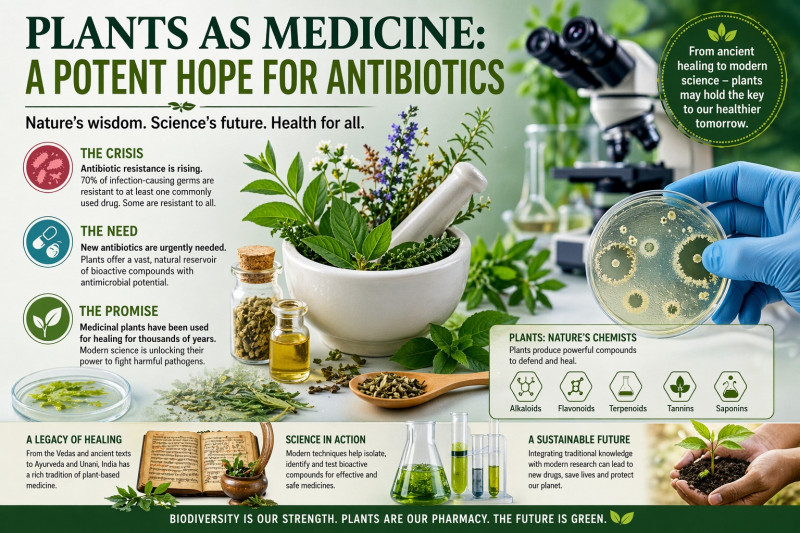
However, this defense is rapidly weakening. An estimated 70% of disease-causing microbes today show resistance to at least one commonly used antibiotic. Some, like Staphylococcus aureus, Mycobacterium tuberculosis, and Pseudomonas aeruginosa, have evolved resistance to multiple drugs. Others, such as Clostridium difficile, have adapted even within hospital environments, making infections harder to control.
This rise in multidrug-resistant pathogens is not just a medical issue—it is a societal one. Routine surgeries, childbirth, and even minor infections are becoming riskier. The antibiotic era, once considered one of the greatest achievements of modern medicine, is under serious threat.
Rediscovering Nature’s Pharmacy
In the face of this crisis, researchers are increasingly looking toward medicinal plants as a source of new antimicrobial agents. Unlike synthetic drugs, plants produce a vast array of bioactive compounds as part of their natural defense mechanisms. These compounds—alkaloids, flavonoids, terpenoids, and steroids—often possess antibacterial, antiviral, and antifungal properties.
Historically, more than 90% of medicinal agents were derived from plants. Even today, traditional systems such as Ayurveda, Unani, and Siddha continue to rely heavily on plant-based treatments. In countries like India, where biodiversity and traditional knowledge systems are deeply intertwined, medicinal plants remain an essential part of healthcare for a large segment of the population.
Ancient texts like the Rigveda and Atharvaveda document the use of plants for healing as early as 1200 BCE. Later works such as the Charak Samhita and Sushruta Samhita laid the foundation for systematic medical knowledge. This continuity of plant-based medicine across centuries is not merely cultural—it is empirical.
Science Meets Tradition: The Rise of Phytochemistry
What distinguishes today’s exploration of medicinal plants from ancient practices is the role of modern science. The field of phytochemistry—the study of chemical compounds in plants—has revolutionized our understanding of how plant-based medicines work.
Advanced techniques such as chromatography and spectroscopy (including UV, IR, NMR, and mass spectrometry) now allow scientists to isolate, identify, and characterize bioactive compounds with precision. These tools have enabled researchers to move beyond anecdotal evidence and establish scientific validation for traditional remedies.
Importantly, natural product research has already contributed significantly to modern medicine. Many widely used drugs have their origins in plant compounds. The challenge now is to harness this potential systematically to combat antibiotic resistance.
Evidence from Research: Plants as Antimicrobial Agents
Recent studies have begun to validate the antimicrobial properties of various medicinal plants. Extracts from plants such as Aloe vera, Mangifera indica (mango), Rosa centifolia, and Pterocarpus marsupium have demonstrated inhibitory effects against both Gram-positive and Gram-negative bacteria.
Using methods like the well diffusion assay, researchers have observed measurable “zones of inhibition,” indicating the ability of plant extracts to suppress bacterial growth. While the effectiveness varies across species and compounds, the results are promising.
These findings reinforce a critical point: nature possesses a vast and largely untapped reservoir of antimicrobial agents.
However, it is equally important to approach these findings with scientific rigor. Preliminary results must be followed by extensive in vitro and in vivo studies, dosage standardization, toxicity assessments, and clinical trials before plant-based compounds can be developed into reliable medicines.
Advantages and Challenges
Plant-based antimicrobials offer several potential advantages. They often have multiple mechanisms of action, making it harder for bacteria to develop resistance. They may also be less toxic at therapeutic doses and more accessible in regions with limited healthcare infrastructure.
Yet, challenges remain. Standardization is a major issue. The concentration of active compounds in plants can vary depending on environmental conditions, harvesting methods, and processing techniques. Additionally, some plant compounds can be toxic at higher doses, underscoring the need for careful dosage control.
There is also the challenge of integration—how to incorporate traditional knowledge into modern medical systems without compromising scientific standards.
A Way Forward
The future of medicine may not lie in choosing between synthetic drugs and natural remedies, but in integrating the two. A hybrid approach—combining the precision of modern pharmacology with the diversity of natural products—could offer a sustainable solution to antibiotic resistance.
Governments, research institutions, and pharmaceutical industries must invest in interdisciplinary research that bridges traditional knowledge and modern science. Equally important is the conservation of biodiversity, as the loss of plant species could mean the loss of potential cures.
Public awareness is also crucial. Responsible use of antibiotics, combined with increased acceptance of scientifically validated plant-based treatments, can help slow down the resistance crisis.
Returning to Roots for the Future
The story of medicine has come full circle. From ancient herbal remedies to modern antibiotics and now back to plants, humanity’s quest for healing continues to evolve. What is different today is our ability to understand, refine, and apply nature’s wisdom with scientific precision.
Medicinal plants are not a relic of the past—they are a promise for the future.
In the fight against antibiotic resistance, the green world may well hold the answers we desperately seek. But this promise will only be realized through sustained research, responsible innovation, and a renewed respect for the natural systems that have supported life for millennia.
The question is no longer whether plants can help us—it is whether we are willing to invest in understanding them before it is too late.